From town shows to war zones: what the RAF’s marketing leaves out
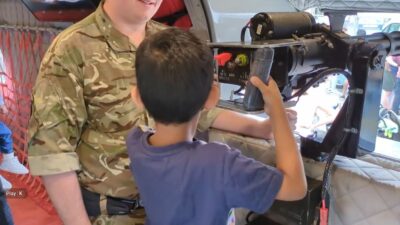
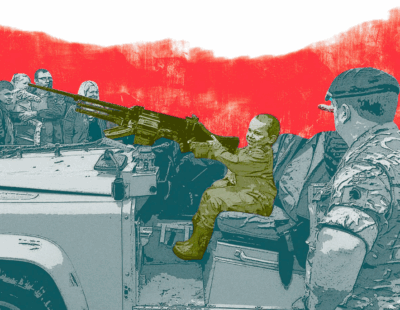
This summer, the Royal Air Force has brought its ‘Town Show’ to public spaces in the heart of towns and cities across the UK. The events showcase military hardware and offer participatory activities that use conflict scenarios as a backdrop for play and skills testing for children and young people. These high-profile, militarised events exemplify how marketing by the armed forces – aimed at both prospective recruits and the wider public – has intensified over the past two years. We explore how this promotion, including events and materials aimed at parents, sells a version of military life that emphasises personal fulfilment, inclusion and peacekeeping, while depoliticising the RAF’s contentious involvement in conflict.
Introduction
The Royal Air Force’s recruitment advertising has historically employed a differentiated tone and style to other parts of the armed forces. Occupying a particular place in Britain’s cultural memory, and less burdened with ‘cannon fodder’ associations, the RAF tends to promote its ethos through its technical and professional expertise, with the notable distinction of aviation skill and craft being at the core of its activity.
Much of the focus of RAF recruitment is towards graduates or young people in post-secondary education and those considered to have STEM-based skills. Its adverts for a general audience are increasingly in the ‘epic’ or tech fantasy realm – particularly the The Ultimate Level campaign from 2021 and The Force Protecting Space campaign from 2023.
As with the other forces, there has been a large push towards diversity of race and gender and a keen emphasis on inclusivity. How young people can prosper within the institution forms a large part of its messaging, which is paired with a significant focus on the variety of roles available and reference to its involvement in humanitarian operations. The RAF Town Shows and the webinars for parents – or ‘gatekeepers and guardians’ – provide opportunities for the organisation to engage directly with potential recruits and their families with this messaging.
But, while the RAF sells itself as a modern, technologically sophisticated, relevant, accountable and professional body of the British military, the political context of its activities is almost totally obscured in its recruitment marketing. Yet it has been involved in some of the most contentious conflicts of the last two decades, with devastating consequences on the ground.
The RAF is coming to town
A central dimension to current RAF recruitment are the Town Shows, weekend-long ‘action-packed’ events which form a significant part of public outreach along with public airshows and community events, and events in schools, colleges and careers fairs. With the climate of global instability and the dominance of political narratives that demand the country is made war-ready, this new type of high profile public engagement is not surprising.
Children may be invited into a Typhoon cockpit to ‘soak up the thrill’ or take the ‘RAF VR Experience’ for ‘the adrenaline of a real scenario and [to] prove that you’ve got what it takes’.
RAF Town Shows took place in 15 locations (archived) in the summer of 2025, and in another 15 (archived) this year. Touring many of the old industrial towns and cities of Britain, but also visiting London and cities in the south east and south west of England, the RAF Town Shows target young people and their families with streamlined promotional messaging promising a secure profession and an opportunity to make a positive contribution. These are very public events that aim for high visibility.
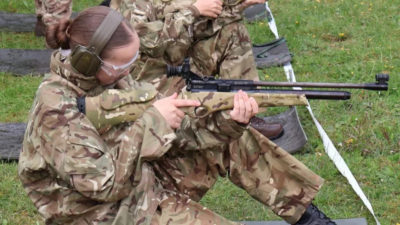
The pop up ‘military villages’ offer a space for children and young people to test their problem-solving skills and other capabilities through tech-based activities, video games and simulators. Aircraft and weaponry are on display with visitors encouraged to get ‘hands-on experience’ of them. Children may be invited into a Typhoon cockpit to ‘soak up the thrill’ or take the ‘RAF VR Experience’ for ‘the adrenaline of a real scenario and [to] prove that you’ve got what it takes’.
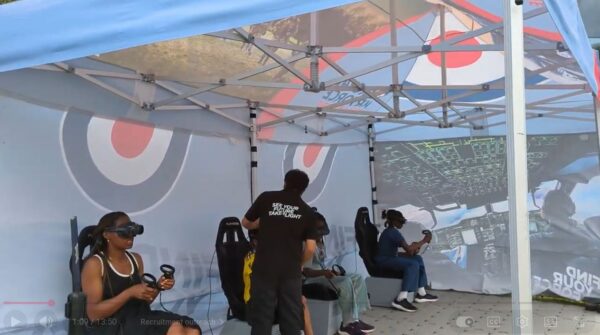
A still from the video ‘The Square – RAF Recruitment and Peace Protest in Luton’ by Zakir Hossain, 2026
There are also stalls focusing on various support roles within the RAF, such as chefs, medics and first aid, military work dogs, as well as ‘STEM discovery’, ‘survival challenge’ and ‘insider career insights’.
Adjacent to the Town Shows that occupy public space in city centres, the online messaging which these events direct young people towards promises the chance to ‘find your force’ and ‘fulfil your potential’ through travel, sport, and adventure alongside an emphasis on apprenticeships and engineering. Marketed as ‘no ordinary employer’ for those who have ‘a desire to lead a less ordinary existence’, and as ‘not just a job but a way of living’, the aspirational ambition to discover the world and make friendships, whilst being paid, housed and catered for is sold as a dream to be achieved. In an increasingly precarious world, with economic uncertainty, endemic deprivation and the overhanging threat of the climate crisis, it is easy to understand the ways in which these promises are infinitely appealing to a disenfranchised generation.
Marketing vs. reality
These recruitment tools are not new and, alongside other branches of the armed forces, the RAF have always drawn on the somewhat contradictory ideals of adventure and financial security in order to appeal to young men and women who are looking to escape lack of opportunity. ForcesWatch and Medact critically reported on these issues in 2019, identifying how recruitment materials exploit problematic narratives in order to market an idealised version of military service. Our report highlighted how recruitment materials sell an idea of military life as superior to civilian life, strategically utilising diversity in particular to present a picture of a modern, egalitarian and forward-thinking military.
However, while the armed forces have put significant effort into recruiting women and from ethnic minorities in order to fulfil recruiting targets, diversity remains tokenised rather than reflective of a cultural change within the military. It continues to be a key aspect of RAF recruitment which prides itself on being a ‘force for inclusion’. However, in recent years, high levels of bullying (Armed Forces Continuous Attitude Survey page 15) and sexual harassment in the armed forces have not abated and reports and investigations on inappropriate behaviours – particularly for women and girls – continue along with high profile cases, such as the investigation into the culture of the RAF’s Red Arrows which found that predatory behaviour was ‘widespread and normalised’.
‘Making a difference’
At a time when global tensions are escalating, the Town Shows and other recruitment marketing are intensifying these well-worn narratives of self-fulfilment, diversity and inclusion but also leveraging another uplifting narrative which recasts international involvement as essentially humanitarian.
The core narrative of armed forces recruitment marketing continues to be that it is a route to self-development and career satisfaction. This focus sells the military as inherently apolitical whilst simultaneously obscuring questions of risks to physical and mental health, moral injury and moral harm.
At a time when global tensions are escalating, the Town Shows and other recruitment marketing are intensifying these well-worn narratives of self-fulfilment, diversity and inclusion but also leveraging another uplifting narrative which recasts international involvement as essentially humanitarian. These are heavily reflected in the messaging designed primarily for the parents – or ‘gatekeepers and guardians’ – of the young people sought for recruitment.
But for the presence or images of military hardware, it would be hard to ascertain from the events or the organisation’s recruitment website what the RAF actually does. The focus is very much on what prospective recruits and their families want to hear, and messaging that pairs ‘stronger together’ – emphasising that there is a role for everyone in the RAF – with ‘make a difference’. The RAF state that it ‘is ready at a moment’s notice to provide essential support, delivering aid to natural disaster zones in the case of cyclones, floods and hurricanes in the UK and across the globe… Our presence in these regions helps to keep people safe.’
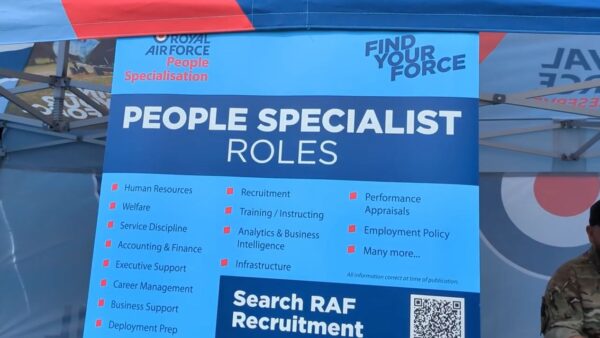
A still from the video ‘The Square – RAF Recruitment and Peace Protest in Luton’ by Zakir Hossain, 2026
On the website, potential recruits are invited to watch a simulated humanitarian mission which foregrounds various roles within the RAF against the backdrop of an anonymous ‘humanitarian crisis in a foreign country’. Viewers are presented with the ‘aid drop challenge’, and asked to press the button to release aid at the appropriate time. With their more direct engagement with target audiences of young people, the RAF’s social media channels foreground the variety of roles available and that everyone has a place, and condense the idea of the RAF providing national and international security to the very simplified ‘be the reason that people are protected’.
Navigating the ‘gatekeepers’
The language of ‘gatekeepers and guardians’ itself speaks to a militarised approach of viewing parents as influential and therefore an obstacle that must be navigated around.
The RAF’s presence in a town centre is an opportunity for them to connect both directly to young people and the significant people in their lives. The monthly webinars for ‘gatekeepers and guardians’ are designed to speak primarily to care-givers and mitigate their concerns for their children’s safety and security. The language of ‘gatekeepers and guardians’ itself speaks to a militarised approach of viewing parents as influential and therefore an obstacle that must be navigated around. The process pacifies parental concerns while positioning parents with a privilege of responsibility.
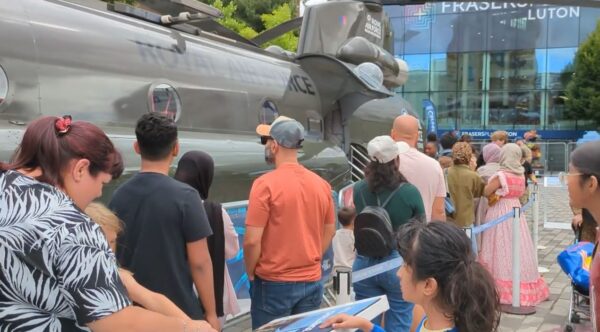
A still from the video ‘The Square – RAF Recruitment and Peace Protest in Luton’ by Zakir Hossain, 2026
On the webpage for parents and guardians the RAF states that their children will ‘play a key role in one of the world’s most advanced military forces with the opportunity to be a part of everything, from preventing civil war to delivering humanitarian aid to hosting ceremonial events.’ Amongst an array of reassuring points, the guide for parents states that, ‘our job is to protect the United Kingdom against any form of threat. We also act as a force for good in the world by working to strengthen international peace and security.’ Humanitarianism becomes a particularly important aspect of marketing aimed at parents, helping to draw the ‘gatekeepers’ in to get them onside in the process of recruitment. Subverting the tone from fighting to peacekeeping reinforces the idea of the profession as something highly aspirational. Peacekeeping is something that parents can be proud of; it buys into historically entrenched ideas of the RAF’s role and the hope to be part of something bigger than oneself, but with a modern, and seemingly politically neutral and liberal dimension.
The reality of the operations on the ground
The streamlined corporate messaging glosses over the reality of the RAF’s role in adding to international insecurity and exacerbating humanitarian crisis with the involvement of the UK military in sometimes illegal and often devastating military action.
That this career pathway is far from politically neutral is neatly obscured by such vague, positive affirmations. The streamlined corporate messaging glosses over the reality of the RAF’s role in adding to international insecurity and exacerbating humanitarian crisis with the involvement of the UK military in sometimes illegal and often devastating military action. This has been particularly evident in the Middle East and North Africa where the RAF’s history of ‘air policing’ goes back one hundred years.
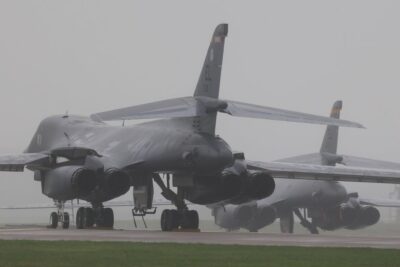
The RAF was directly involved in the catastrophic 2011 attack on Libya and and was involved in the provision of intelligence support to the Israeli military during its genocide against Palestinians in Gaza from 2023. In Yemen, they provided engineering and training support to Saudi Arabia for its bombing campaign against Houthi-controlled areas between 2015 and 2022, during which over 25,000 airstrikes created an immense humanitarian crisis. In early 2024 the RAF took a more direct role in the US bombing of Houthi targets in Yemen.
Last year, RAF refuelling planes supported the US Operation Rough Rider, a two month long bombing campaign which attempted to target Houthis in Yemen and prevent a ground blockade of Israeli linked shipping in the Red Sea. Britain authorised the deployment of RAF Voyager Tankers which flew 25 separate missions from Akrotiri airbase in Cyprus, supporting US air strikes.
While the involvement is presented as helping keep prices down for people in the UK, it risks intensifying the conflict with the human cost borne by people living in the region.
Flight tracking data accessed by Declassified and Airwars verify the RAF’s assistance to the US navy and air force in the Red Sea. This included strikes on the port of Ras Issa which resulted in multiple civilian deaths, including first responders and medical personnel. Moreover, the destruction of the civilian port, a critical site for distribution of humanitarian aid adds unquantifiable civilian harm that Human Rights Watch called ‘particularly atrocious considering the immense humanitarian needs in Yemen’. According to a US Department of War report released this year, Operation Rough Rider resulted in 154 civilian deaths and a further 243 civilians injured in three air strikes, two of which the RAF can be linked to through the flight tracking data. RAF involvement in these activities ‘may make them complicit in war crimes’ according to Human Rights Watch. Despite – or because of – the political tensions between the UK and Europe with the Trump administration, the UK’s participation in the bombings was partly justified on the grounds of showing support for the US.
In September this year, Britain offered the RAF to assist in refuelling Saudi Arabian fighter jets in a new wave of air strikes against the Houthis. Defence Minister Luke Pollard stated that the military air support to Saudi Arabia is ‘purely defensive’ and fully compliant with international law. This refuelling activity has since been extended to 90 days and will also ‘fly defensive missions to help defend Saudi cities and critical infrastructure’. The Ministry of Defence framed the support as serving the UK’s economic and security interests, as disrupted energy supplies were raising costs for British businesses and households. Yet while the involvement is presented as helping keep prices down for people in the UK, it risks intensifying the conflict with the human cost borne by people living in the region.
A personal solution to political crisis?
There’s no doubt that young people in the UK are facing an increasingly precarious future, and that this is also fuelled partly by conflict overseas and the insecurity it creates across the globe. The British military’s participation in this – justified on the basis of economic, political or national security interests – has a track record of exacerbating and creating more instability for communities not only in the areas of conflict and also more widely.
The intensification of the RAF recruitment drive, with its emphasis self-fulfilment, diversity and inclusion, and making a positive impact on the world, attempts to assuage the anxieties of young people – and their families – and to encourage them down a pathway that promises a personal solution to these large political crises. Whatever the reality of the glossy promises for personal fulfilment made by these marketing campaigns, another far less comfortable reality is that participation in the armed forces involves personnel and their families directly within the dynamics of global insecurity and inequality.
See more: human rights, recruitment, STEM, advertising
Like what you read?
> Sign up for our newsletter or blog notifications
> Support our work – from just £2 a month