A war of choice, mass civilian killing and the consequences of militarism
The UK government has positioned itself as reluctantly cooperating with the aggressors but has failed to condemn the war. With the legality of the UK’s cooperation in doubt, Starmer’s pre-election pledge for ‘no more illegal wars’ and the government’s rhetoric in support of international law looks questionable.
The people of Iran are being terrorised as they experience the simultaneous power of states to inflict crushing violence on two separate fronts. We must show solidarity with their struggle against military and political violence and for their liberation, justice, peace and human rights.
Mass bombardment of civilians
The US-Israeli mass bombardment of Iran has unleashed hellish scenes across much of the country and has inflicted incalculable suffering on Iran’s population. In addition to the brutalisation of Iranian civil society by the US and Israel, Iranians had endured extreme violent repression in the weeks preceding the war by government forces in response to mass civil protests.
Iranian civilians have paid the overwhelming price of this war of choice. At least 1,330 Iranian civilians, including over 200 children, have been killed and a further 17,000 wounded since the US and Israel launched their war on 28 February. Reportedly, the youngest of those killed so far by US-Israeli forces was an 8-month-old girl. In addition, 1,122 military personnel and a further 613 people (not yet classified as civilian or military) have also been killed. Over 3 million Iranians have been displaced according to the UN High Commissioner for Refugees.
The Iranian Red Crescent Society reports that over 20,000 non-military structures have been damaged, including 17,353 residential structures.
The scale of destruction on Iran inflicted by the US and Israel cannot be understated. The first days of the US-Israeli campaign of indiscriminate bombardment saw far more sites struck than any recent US or Israeli military campaign. Over 200 cities have been targeted. The Pentagon estimates that during the first two days of bombardment, the US dropped more than 2,000 munitions worth close to $6 billion. The Israeli Air Force had dropped more than 7,500 bombs on Iran by 7 March 2026.
The Iranian Red Crescent Society reports that over 20,000 non-military structures have been damaged, including 17,353 residential structures. Civilian infrastructure has been repeatedly damaged or destroyed, including thousands of residential buildings, schools, public markets, public squares, a water desalination plant and sports arenas. 87 health units, 24 medical centres, 21 emergency bases, and 18 ambulances have reportedly been damaged. Numerous cultural heritage sites have also been damaged in the relentless bombardment, including the Golestan Palace, Isfahan’s Shah Mosque and the Tehran Grand Bazaar.
On the first day of their campaign of bombardment, the US bombed the Shajareh Tayyabeh Girls Primary School in Minab in the south of Iran, killing over 175 civilians, the majority of whom were school girls aged between 7 and 12 and their teachers. A further 95 people were wounded in the attack. Haunting images have been released of a number of freshly dug graves for the girls and their teachers. The UN has labelled the strike a grave violation of international law. Human Rights Watch has called for the attack to be investigated as a war crime, pointing to the patterns of strikes as evidence that ‘highly accurate, guided munitions’ were used. Investigations by Bellingcat and others found that a Tomahawk missile struck the school. Both the US and Israel denied involvement, with US president Donald Trump originally alleging that Iranian forces were responsible, yet the US is the only known party to the conflict to have Tomahawk missiles. A US military investigation has now found that the US was responsible.
Double-tap strikes
An investigation by Al Jazeera’s digital investigations unit found ‘definitive visual confirmation’ dating back to 2018 that ‘the building was operating at full capacity as a primary school’. Satellite imagery revealed clear features of the school such as a children’s sports field, bright mural drawings and civilian cars lined up outside the school’s external gate. A BBC Verify investigation found evidence of multiple strikes on the school. Testimony given to Middle East Eye by a father of one of the girls killed in the attack reveals the girls were moved to a prayer hall after a first bomb struck the school. The principal had called the parents to come and pick up the children but the school was struck again shortly after. The bombing of an area with a short pause between each strike is known as a ‘double-tap’ strike. Civilians in Tehran have also reported the use of ‘double-tap’ strikes. Israel is also known to have deployed the use of ‘double-tap’ strikes during its bombing in Gaza.
‘Death and destruction, all day long’
On 4 March, US Secretary of War, Pete Hegseth, unashamedly boasted that the US-Israeli bombardment of Iran will involve ‘death and destruction, all day long’. He also said, ‘our warfighters have maximum authorities granted personally by the President and yours truly’ and that ‘this was never designed to be a fair fight’. Hegseth’s disgraceful remarks rang true days later when on 7 March, Israel launched an unprecedented attack on Iran’s energy infrastructure, bombing over 30 oil facilities. Several oil depots to the north of Tehran and a refinery in the south of Tehran were bombed.
As a result, Iran’s capital city, home to roughly 10 million, was engulfed in a dark cloud of poisonous smoke released from oil infrastructure set ablaze by Israeli bombardment. Tehran’s citizens reported the sun being blocked out by the apocalyptic cloud, which has since rained down black rain across the city. Some of Tehran’s roadside storm drains became ‘fast-flowing rivers of fire … setting streets ablaze and spreading flames through the urban drainage network’.
A resident told Amnesty International:
‘The air was pitch black. It is daytime, but it’s dark like night. The city is full of soot, I went outside. It was raining a little, and my hands became black immediately. Soot is falling from the sky. It is terrifying.’
The UN World Health Organisation has outlined that the ‘massive release’ of a concoction of poisonous chemicals, including ‘toxic hydrocarbons, sulphur oxides and nitrogen compounds’ presents significant danger for Iranians.
It is difficult to interpret this as anything other than an attack on the entire population of Tehran, and surrounding areas as the cloud was dispersed by the wind. International law is explicitly clear that military actions must not cause disproportionate harm to civilians or damage civilian infrastructure. This bombardment has exposed millions of civilians to potential significant health risks. The Conflict and Environment Observatory offers in-depth critique on the potential health impacts inflicted on Iranians and the massive environmental implications of the airstrikes.
The targeting of Iranian civilian areas is not new. During the so-called ’12 Day War’ between 12 June and 25 June last year, Israeli airstrikes killed 1,190 Iranians, of whom 436 were civilians, with a further 319 unidentified fatalities. At least 132 women and 45 children were killed. Over 2,000 civilians were confirmed injured in the attacks. Both Human Rights Watch and Amnesty International called for Israel’s airstrike on Iran’s Evin Prison to be investigated as a war crime.
A US-Israeli war of choice
The US and Israel launched the current war under a pretence of ‘defence’. The US claimed that ‘pre-emptive strikes’ were a necessity to ‘eliminate the imminent nuclear threat posed by the Iranian regime’, despite the US and Iran having made important progress in mediative talks just hours prior. Oman’s Foreign Minister stated that significant advancements had been made between the US and Iran the night before the attacks started, and that Iran had agreed to historic concessions, including the degrading of its nuclear material to the ‘lowest possible level’ and the acceptance of comprehensive inspections by the International Atomic Energy Agency. He has suggested that this demonstrates the conflict was solely an attempt to reorder the Middle East in Israel’s favour.
UN experts have condemned the war as an act of aggression and a ‘flagrant violation of international law’.
The war is clearly an unprovoked illegal act of aggression in violation of the UN Charter. Article 2(4) prohibits the use of force against the territorial integrity or the political independence of any state, with the exceptions of UN Security Council authorisation or the necessity of self-defence in response to an imminent or actual attack. Neither the US nor Israel were under imminent threat by Iran. UN experts have condemned the war as an act of aggression and a ‘flagrant violation of international law’.
Since launching the war under the pretence of ‘defence’, both Israeli and US leaders have shifted their narrative a number of times, and used extremist religious rhetoric in their framing of the war. A US watchdog, the Military Religious Freedom Foundation, has reported that a US commander told officers to tell their troops that the bombing of Iran was ‘all a part of God’s divine plan’, referring to Armageddon and a return of Jesus Christ. On 12 March, Trump described Iran as ‘a nation of terror and hate’.
In response to US-Israeli attacks, the Iranian Revolutionary Guard Corps (IRGC) launched significant numbers of airstrikes against 27 American military bases stationed in several neighbouring states in addition to Israeli military targets, deploying the use of drones and missiles in its retaliatory bombardment. Seven US military personnel have been killed in addition to 12 Israeli civilians. Iran’s airstrikes have endangered civilians, hitting civilian infrastructure such as hotels and have killed at least 30 people across 6 countries, including tens of civilians in Persian Gulf States, most of whom were migrant workers. Such strikes fall outside the remit of the right to self-defence and constitute a violation of International Humanitarian Law.
AI harnessed for war
At the same time that AI companies in the US have been disputing the terms of their increasing involvement in warfare with the Pentagon, and competing for the military contracts, the reality is that Anthropic’s AI model ‘Claude’ has been used during the US bombing to ‘shorten the kill chain’. Rights groups such as Stop Killer Robots have long raised concerns around oversight, legal accountability for serious international crimes and the inability of artificial intelligence to understand the sanctity of human life. Israel is known to have used an AI system called ‘Lavender’ for target selection during the genocide in Gaza, where it has been claimed that personnel overseeing the target list would only devote 20 seconds to each target before authorisation.
Lebanon bombardment and displacement
Concurrently, Israel is leading another campaign of indiscriminate bombardment, in addition to a ground invasion, in Lebanon following Hezbollah’s bombing of Israel in response to the killing of Ayatollah Ali Khamenei. Human Rights Watch report that Israel has illegally deployed the use of white phosphorus. Despite an apparent ceasefire between Hezbollah and Israel in November 2024, it was reported in October last year that Israel had continued to bomb Lebanon almost daily. Numerous residential buildings and streets have been flattened, and the use of ‘double-tap’ strikes are reported. Over 800,000 Lebanese civilians have now been forcibly displaced across the country, and ‘entire families wiped out and towns emptied’. At least 687 Lebanese civilians have been killed, including 98 children, with a further 1,586 injured. Human Rights Watch has urged countries such as the US and UK to suspend military assistance and arms sales to Israel, and to impose targeted sanctions on officials credibly implicated in such grave crimes.
The UK as a facilitator of unlawful acts
The UK government has attempted to position itself as a reluctant, indirect participant in the war on Iran. However, through its collaboration with the US military, the UK has once again displayed an acceptance of militarism and its use of brute force, mass civilian killing and the degradation of international law. Prime Minister Keir Starmer claims to have learned from Iraq, having asserted that he will not allow the UK to join the war without a ‘lawful basis’, yet has been drawn into facilitating a war which is illegal both in its mandate and conduct.
Having initially rejected Trump’s demands to use UK bases due to uncertainty regarding the legality of the US actions, Starmer reversed this decision on 1 March, granting the US use of RAF Fairford in Gloucestershire and Diego Gargia in the Indian Ocean to bomb Iranian missile depots and launch sites. After RAF Akrotiri in Cyprus was struck by a drone that same day, the UK also said it would be involved in shooting down Iranian drones launched at allies it said had requested help. These decisions were framed explicitly as a form of ‘defence’, with Starmer claiming:
‘As well as defending itself and its position in the region, the UK is acting in the collective self-defence of regional allies who have requested support.’
The views of international law scholars vary in relation to the legality/illegality of the UK’s involvement, in addition to the legality of Iran’s retaliatory strikes and the rights of neighbouring states struck by Iran. However, almost all agree that the US-Israeli war on Iran is a clear example of a violation of the UN Charter. In his assessment, Professor Adil Haque of Rutgers Law School, and author of Law and Morality at War, concluded that the UK’s stated intent to use ‘military assets flying in the region to intercept drones or missiles targeting countries not previously involved in the conflict’ would appear lawful under article 51 of the UN Charter.
Perhaps the greatest evidence of the UK’s role in such aiding or assisting unlawful acts of aggression is to be seen at British military bases.
The UK has flown its fighter jets over a number of Persian Gulf states, shooting down a number of drones. However, through granting permission to the US to use British bases to launch airstrikes, the UK is potentially aiding or assisting an aggressor in the commission of an unlawful act of aggression. Haque outlines that strikes against missile facilities in Iran are ‘an important component of the composite act of aggression’, elaborating that the threat of Iranian strikes would be ended by ceasing the US-Israeli ongoing aggression which represents a war of choice, rather than necessity.
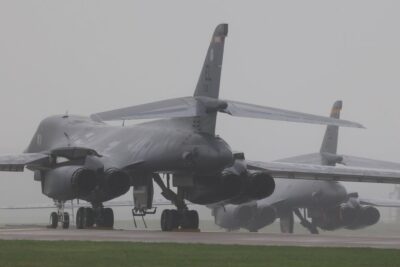
Perhaps the greatest evidence of the UK’s role in such aiding or assisting unlawful acts of aggression is to be seen at British military bases. Several US military aircraft, including the B2-Spirit Stealth Bomber, six B52 and twelve B1 Lancer bomber planes, have been allowed to land, restock and refuel at British military bases in the UK, most notably RAF Fairford since 1 March. US soldiers have been filmed at Fairford openly loading GBU-31 Joint Attack Direct Munitions (JDAMs) armed with BLU-109 2000-lb bombs onto B1-B Lancer bomber planes. It has been reported that 3 B1 Lancer bomber planes arrived back at RAF Fairford on 11 March after a 15-hour mission to Iran.
Additionally, the UK allowed US military aircraft, including fighter jets and aerial refuelling tankers, to transfer via UK bases, namely RAF Lakenheath and Mildenhall, to bases in West Asia over a number of weeks leading up to 28 February. Open-source analysis by the BBC also found that US military planes (3 Boeing KC-135 Stratotankers) had landed at Prestwick Airport, a Scottish government-owned airport, in the weeks leading up to 28 February. The three planes have since been stationed at Ben Gurion airport and have flown at least 30 missions from Israel to Iran and are likely to have refuelled Israeli aircraft during their mass bombing runs.
Starmer’s pre-leadership pledge on peace and justice
Despite the insistence that its involvement in Iran is purely ‘defensive’, the Labour government’s current approach is a far cry from the promises that Keir Starmer ran on during his 2020 leadership bid, in which he made 10 pledges. Pledge 4 read the following:
‘No more illegal wars. Introduce a Prevention of Military Intervention Act and put human rights at the heart of foreign policy. Review all UK arms sales and make us a force for international peace and justice.’
Further, during his candidacy to become Labour leader, Starmer expressed support for giving Parliament a vote on military action. Labour’s subsequent support for military action in Yemen in early 2024 led to questions over those earlier commitments. In an interview in January 2024 Starmer said he stood by the principle of his earlier comments and that, if Labour won the next election (subsequently held in July 2024), parliamentary approval for deploying troops was ‘a principle that I want to see entrenched’. Despite calls for a vote by opposition MPs in the Commons debate the day after the US was granted permission to use UK bases, Starmer stated that a parliamentary vote was not necessary as the UK’s action was only ‘defensive’.
The Labour government has taken a selective approach to the protection of civilians, adherence to international law and the universality of human rights.
Whilst the Labour Party took a considerably more militarist stance during its 2024 election than that inferred in Starmer’s leadership campaign, its 2024 manifesto stated that ‘Labour values international law because of the security it brings’. Despite this, the Labour government has taken a selective approach to the protection of civilians, adherence to international law and the universality of human rights, evidenced by its role in the genocide in Gaza.
Additionally, it is crucial to place the UK’s continued collaboration with the US in the context of US Secretary of War, Pete Hegseth’s, declaration in September last year that the US would not be bound by ‘stupid rules of engagement’, proclaiming that his ‘warfighters’ would be permitted to use ‘maximum lethality’. This is an explicit rejection of the rules of war, which he repeated on 2 March, just one day after Starmer granted the use of UK bases to the US.
Whilst positioning itself as a reluctant participant, the UK government was criticised for echoing the US government’s ‘memeification’ of its war on Iran.
The UK’s collaboration with the US military diverges from many of its EU allies. The leaders of Spain, Italy, France and the Netherlands have all openly condemned the US-Israeli war on Iran as explicitly illegal or in violation of international law. However, their consequent actions regarding ceasing military collaboration with the US and Israel vary. Spain’s Prime Minister, Pedro Sánchez, has taken the most principled stance against the US, denying the US the use of its bases and withdrawing the Spanish ambassador to Israel. Both France and Italy have independently opened direct talks with Iran to secure passage for their ships through the Strait of Hormuz to restart energy shipments, marking the limits of Washington’s ability to co-opt the full support of European states in the US-Israeli war on Iran and its civilians.
Whilst positioning itself as a reluctant participant, the UK government was criticised for echoing the US government’s ‘memeification’ of its war on Iran, in its styling of a post about Britain’s action. Footage set to music was posted on Starmer’s official TikTok account on 6 March (now removed) showed him alongside fighter jets taking off and bombings. Perhaps the irony of using Dire Straits’ ‘Money for Nothing’ was missed by Starmer’s media team. The White House’s official X account has posted numerous edits syncing videos of bombing runs to famous songs, movies, video games and cultural moments of significance.
A war with very little support
Much of the UK’s mainstream media has placed Starmer’s response within a predictable critique of the UK’s ostensible inability to mobilise quickly, whether to Cyprus, the Strait of Hormuz, or to simply project a form of ‘Global Britain’ rooted in military might and ‘national interests’.
However, despite the relentless banging of the war drum in recent years from much of the UK’s media and political class, there has been considerable public opposition to any UK involvement in this particular war. Almost 60% of people in the UK are opposed to the US-Israeli war on Iran, with 37% strongly opposed. Amongst Green, Liberal Democrat and Labour voters, a majority of those questioned are strongly opposed to the war. Amongst Conservative voters, as many oppose the war as support it, despite their leader’s initial ideological and pro-Trump stance. Only 10% of people in the UK are strongly in support of the US.
Political opposition to the war has also taken place, with both the Green and Liberal Democrat parties demanding a parliamentary vote over the use of UK bases by the US. Starmer has also witnessed opposition from within his own party, including the Labour chair of the Foreign Affairs Committee, who deemed the US-Israeli strikes a violation of international law. Labour MP, Clive Lewis, released a statement asserting ‘this has the unmistakable feel of mission creep’, sowing doubt in the narrative of the ‘defensive’ nature of the UK’s participation.
Militarism as a hierarchical understanding of human rights
Between its military collaboration with Israel during the genocide in Palestine and now its collaboration with the US during its illegal war on Iran, Starmer’s government has contributed to a world where increasing militarisation, mass civilian murder, rejection of accountability mechanisms and permanent war is the increasing norm. As highlighted in Rethinking Security’s assessment, the UK continues to allow itself and its security to be emeshed into the US-led military industrial complex, despite the extremism of the white Christian nationalist Trump government.
In its limited, but tangible, capacity to influence the situation, the UK must unequivocally condemn the US-Israeli war of aggression against Iran. It must reverse its permission for the US to use UK bases to attack Iran, which likely constitutes the unlawful aiding or assistance of an illegal act of aggression. Ultimately, such decisions must be placed within a wider, comprehensive re-strategising of defence for the UK, which must centre human security and just peace efforts. This must include the decoupling of US-UK defence structures such as significant projects such as the F-35 jet. The UK provides 15% of all components for the F-35 jet, which has been used extensively by Israel during its genocide in Gaza and is now being used in the bombardment of Iran. The UK government claims that the F-35 programme is central to ‘international peace and security’, but this is a militarised security that is based on readiness to harm others elsewhere rather than one rooted in recognition of collective humanity and equal rights.
The violence inflicted on civilians extends beyond the physical and psychological terrorisation of Iranian civilians, to everyone who will feel the effects of the widening crisis.
The fallout of the war extends beyond the visceral violence inflicted on civilians directly targeted. As the war enters its third week, Iran’s strategy now appears to have shifted to fewer, more targeted strikes on critical energy infrastructure in a number of Persian Gulf states. The war has resulted in shocks to key global economic resources, including massive increases in the price of oil due to an effective closure of the Strait of Hormuz, and a likely global energy crisis. The violence inflicted on civilians extends beyond the physical and psychological terrorisation of Iranian civilians, to everyone who will feel the effects of the widening crisis. Additionally, communities around military bases are in the firing line, including the civilian population of Cyprus. Cypriots have long taken issue with RAF Akrotiri, Dhekelia and Trodos Station as a continuation of colonial relations with Britain, and previously highlighted how the bases made Cyprus a target for potential military attacks, as evidenced by threats from Hezbollah in 2024.
Iranian civil society is being killed on two fronts
It remains crucial to centre the devastating impact of this war on Iranian civilians. Iranian civil society continues to resist severe violent repression from a dictatorship that has long denied their basic rights and citizens now are under threat of death, injury and disease through mass bombardment by the US and Israel.
The long-term physical and psychological damage inflicted on Iranian civil society by the Iranian dictatorship and its security forces cannot be understated. Government-aligned forces have enforced a decades-long policy of mass repression of oppositional voices, including indefinite imprisonment without trial, forced disappearances, mass executions, torture and rape of prisoners, banning of political opposition, threats and beatings.
Iranian civilians have long stood bravely in the face of such injustice. In 2022, following the murder of Mahsa Amini by Iran’s ‘Morality Police’, Iranian civilians led mass protests under the slogan ‘Zan, Zendegi, Azadi’ (Women, Life, Freedom) challenging the dictatorship’s enforcement of gender apartheid. The UN has documented extensive evidence of the IRGC, police and Basij militia using lethal force during the protests, including the use of live ammunition fired from shotguns, assault rifles and handguns on unarmed protestors.
Severe economic sanctions imposed by the US on Iran have caused significant additional suffering amongst the Iranian population. Human Rights Watch found in 2019 that the sanctions cause ‘unnecessary suffering to Iranian citizens afflicted with a range of diseases and medical conditions’, including those with cancer.
In December last year, mass protests began in over 200 Iranian cities. The demands of protestors were diverse but generally oriented around mass dissent against the dictatorship of Iran. The scale of violence and repression enacted by security forces on protestors was huge. Figures vary widely, but the Iranian rights group, the Human Rights Activists News Agency (HRA-NA), has established that at least 6488 protestors were killed by security forces, with over 25,000 injured. Over 50,000 Iranians were arrested with many subjected to varying forms of punishment and torture by security forces. The UN Special Rapporteur Mai Sato has called for an independent investigation to determine if crimes against humanity were committed against Iranian civilians. Sato also suggested that some medical figures she had received had placed the death toll at above 20,000. A report by HRA-NA offers an extensive account of the mass brutalisation of Iranian civil society during these protests.
The Iranian people are experiencing the simultaneous power of states to inflict crushing violence on two separate fronts.
Shortly after the US and Israel launched their war, Iranian authorities cut off access to the internet. This act has made it highly difficult, if not impossible, for Iranians to access critical information, including which areas to avoid and to remain in contact with loved ones. This action has also stopped the flow of information regarding violations of human rights by the USA, Israel and the Iranian dictatorship.
Whilst the US and Israel rain bombs down on Iranian civilians, murdering many of them and endangering millions more, the Iranian dictatorship insists that it will inflict a brutal crackdown on any citizen they deem to be in support of ‘the enemy’. The Iranian people are experiencing the simultaneous power of states to inflict crushing violence on two separate fronts.
As with any country, the political views of Iranian civil society are wide ranging and the rights of its people must be protected. Iranians are not a tool to be used to further the self interest and posturing of nation states. Their terrorisation by military and political violence is not inevitable and the UK must withdraw any support it has given for actions that perpetrate this. We must listen to the testimonies of Iranians, human rights and medical groups in Iran and other international human rights organisations. Iranian society’s collective struggle for liberation, justice, peace and rights must be supported by civil society across the world as we show solidarity against this gross violation of international and moral law.
See more: human rights, military in society, UK Parliament, defence & foreign policy
Like what you read?
> Sign up for our newsletter or blog notifications
> Support our work – from just £2 a month