The AI arms race: the new face of war

Developed by militaries over the last decade, artificial intelligence (AI) is fundamentally changing the nature of warfare. The wars in Ukraine, Venezuela, Gaza and Lebanon have shown the most dramatic demonstration of the shift in the way that warfare is being conducted, described by some as a once-in-a-generation inflection point. The development and use of AI is changing and breaking fundamental ethical, societal and legal conventions, no more so than in its application in the military.
To understand the gravity of this issue, this article will first unpick what AI actually is, to explain the mechanics of these statistical prediction engines. It will then examine how global militaries are currently automating the ‘kill chain’, outline the severe, immediate risks of automation bias and unaccountable algorithms, and assess the catastrophic future trajectory of fully autonomous weapons. Finally, it will highlight the growing global resistance, from United Nations diplomats to tech industry whistleblowers, fighting to establish binding regulations before meaningful human control over life and death is permanently lost.
Contents
- What is AI? The prediction engine
- Bureaucratic algorithms: how are governments currently using AI?
- The battlefield algorithm: how are militaries using AI?
- Algorithms of escalation: what are the current risks?
- Future risks: fully autonomous weapons
- The precipice
What is AI? The prediction engine
Artificial intelligence (AI) is not a single technology; it is a generalised term for a set of technologies that attempt to enable computers to complete tasks that previously could only be done by humans. These include cognitive abilities like perception, reasoning, learning, and understanding language.
Traditional software requires explicit, step-by-step programming to execute a function; if a situation falls outside its programmed rules, it fails. Human intelligence, conversely, can handle context, recognise abstract patterns, and adapt to new information and make predictions based on this new information. AI aims to replicate these flexible, cognitive capabilities that are inherent to the human experience.
To achieve this, AI relies on technologies such as machine learning and deep learning, shifting from rigid programming to ‘neural networks’ that train themselves by processing massive amounts of historical data in a way that mimics the way that a human brain learns. However, to understand AI’s dangers, it is crucial to realise that the AI tools used are fundamentally prediction engines, not an infallible oracle. AI does not ‘know’ or ‘understand’ things the way humans do, it operates entirely on statistical probability.
A familiar example of this is the CAPTCHA test that is often faced when browsing the internet. CAPTCHAs may ask the users to ‘select all images with a bus’; every time millions of humans click those squares, they are acting as unpaid trainers, feeding the AI thousands of visual examples of what a bus is. The machine never actually understands or knows what a bus is or its purpose. Instead, it builds a statistical model of the shapes, edges, and pixel arrangements associated with the label ‘bus’. When the AI is later shown a new photograph, it simply calculates the mathematical probability that the image matches its learned pattern.
This exact same mechanism applies to the use of AI in warfare. If a military AI flags a building or a person as a threat, it is not stating a definitive fact or exercising judgement. It is simply calculating that, based on its training data, there is a high mathematical probability that the target’s digital profile matches the pattern of an enemy combatant or threat.
Finally, generative AI and agentic AI represent the latest steps of deep learning, and include tools such as OpenAI, ChatGPT, Google Gemini, Anthropic Claude, Microsoft Copilot, or xAI Grok. With generative AI, rather than merely analysing or classifying existing information, the model leverages complex statistical correlations and structural patterns mapped from vast datasets to generate new text, audio, and imagery. At its core, particularly when generating language, it operates like an incredibly sophisticated version of the predictive text on a smartphone, it does not ‘think’ or ‘understand’ what it is writing but simply calculates the most mathematically probable next word based on the billions of examples it has processed.
Agentic AI is essentially a layer built around generative AI, to create systems that can accomplish goals with limited human supervision. The term ‘agentic’ refers to the ability of these models, or ‘agents’, to act with agency or independently for a goal. Generative AI models are passive, waiting for a text prompt and generating the most likely response then waiting for the next prompt. For agentic AI, developers wrap the generative AI models in code that gives it a continuous loop of reasoning, planning, and abilities to take action. The ability of agentic AI to interactive with external tools or programmes allows it to access databases, navigate software, and execute multi-step plans.
Bureaucratic algorithms: how are governments currently using AI?
As the world is increasingly trying to understand how to leverage the power of AI, we are also seeing governments use these tools both to streamline certain types of tasks and to analyse and process the massive amounts of data that they hold, ostensibly under the guise of enhancing public service efficiency and driving economic growth.
Many applications of AI are likely to be viewed as fairly uncontroversial and benign, for instance, to speed up simple administrative tasks, deploying systems to spot railways faults, or tools to help identify early signs of neurodegenerative diseases such as Alzheimer’s. There are still deep concerns about the overall political, societal and environmental impacts of AI; such as resource usage, the loss of jobs to AI, the further concentration of power in small numbers of tech companies and CEOs, or contributing to cognitive atrophy due to the reliance on AI.
We have also seen the UK government sign contracts worth hundreds of millions of pounds with the immensely controversial company Palantir to integrate AI models into the MoD or the NHS for analysing data and support operational planning. Palantir is also creeping into areas where the AI is making high-stakes judgements directly impacting individuals, such as police forces using AI-powered live facial recognition or HM Revenue & Customs using machine learning to detect fraudulent activity, non-compliance, and ‘predictive analytics’ in tax filings. Particularly concerning is the integration of AI into the military sphere for purposes of increasing lethality.
The battlefield algorithm: how are militaries using AI?
Arguably, the most controversial area for the use of AI is in military applications where they are already fundamentally disrupting the ethics, accountability, and speed of warfare by delegating life-or-death decisions, either in part or in whole, to machines. AI represents a fundamental shift in how warfare is conducted. The Guardian described its use in the attacks on Iran in February as ‘a dangerous turning point’:
‘When military historians look back at what has happened in the last few months, it’s easy to see them thinking the use of AI in this way will be similar to the nuclear weapons dropped on Japan: marking a moment where there was a clear before, and an unclear after.’
Ukraine
AI has already been used extensively as a tool in recent conflicts such as in the Russia-Ukrainian War. It has supported drone warfare in both reconnaissance and operation, processing thousands of hours of drone footage to identify threats. The AI automatically identifies equipment or enemy positions, which can also be done in real time to facilitate military operations.
In drone operation, AI is commonly used for navigation and overcoming signal jamming. When a drone loses its communication link with the operator due to Russian signal jamming, onboard AI takes over for the ‘last mile’ of the flight, using automatic target recognition to lock onto a target from a distance and execute the strike after human connection is lost.
Israel
Whilst AI application in drone warfare has been a marked feature of the Russia-Ukraine war, the most dramatic demonstration of AI’s impact has been the United States and Israeli militaries’ integration of AI into high level strategic planning and lethal targeting in Venezuela, Gaza, Lebanon and Iran.
After the eleven-day 2021 Israel–Palestine war, the former Israeli Defence Forces (IDF) chief of staff, Aviv Kochavi, boasted that their new AI tools ‘generated 100 new targets every day. To put it in perspective, in the past, we would produce 50 targets in Gaza in a year. Now, this machine created 100 targets in a single day, with 50% of them being attacked.’
In 2023 it was reported that the IDF was using a tool known as ‘the Gospel’, which accelerated the speed of generation of targets to a completely unprecedented level, shifting the bottleneck within lethal strikes from identifying targets to enacting them. Its primary function is to identify buildings, structures, and equipment associated with the IDF’s enemies. By autonomously referencing vast databases of communications, visual intelligence, and social mapping, the AI generated thousands of target recommendations at a pace human intelligence officers could never match.
Israel’s campaign in Gaza also utilised an AI tool known as ‘Lavender’. Developed by the IDF’s Unit 8200, the system was designed specifically to identify human targets by acting as a massive, automated dragnet. Lavender analysed the data of the Gazan population, monitoring communication habits, social media, travel patterns, and personal associations, to assign each person a probabilistic score indicating the likelihood of their membership of an armed group. According to intelligence officers involved in the process, these targets are predominantly ‘junior operatives’ who would never have previously appeared on traditional target lists. Additionally, the Israeli military frequently adopted a dangerously broad definition of an ‘operative’, leading Lavender to flag civil defence personnel, police officers, and administrative officials for assassination. Furthermore, the system’s error rate is incredibly high; by the IDF’s own submissions, 10 percent of people flagged by Lavender were false positives.
The United States
The US military has been one of the first adopters of AI and has been developing tools such as Project Maven since at least 2017, with the aim of accelerating the integration of machine learning and data integration across US military intelligence. In early 2026, the US military recognised the fundamental way that AI will change military conflict proclaiming that, ‘AI-enabled warfare and AI-enabled capability development will re-define the character of military affairs over the next decade’. It asserts its aim to ‘accelerate America’s Military AI Dominance by becoming an “AI-first” warfighting force across all components, from front to back’.
During the illegal US-Israel war on Iran, both militaries relied heavily on AI technologies for target generation. Within the first four days of the war, US-Israeli forces reportedly attacked 4,000 targets. For comparison, within the first 6 months of the US-led coalition’s military campaign against ISIS, over 3,000 targets were struck. The scale and speed of the US-Israeli mass bombardment of Iran would not be possible without relying heavily on AI-generated targeting. This has lead to an almost instantaneous and dramatic spiral of violence that has proved difficult to step back from.
Algorithms of escalation: what are the current risks?
Human oversight and the illusion of control
There are a multitude of deeply concerning implications and risks surrounding these tools. Firstly, on the question of human oversight, the US-Israeli forces, and the companies that provide AI software, claim that ‘fully autonomous weapons’ are not being used, with the justification that a human always makes the final decision on what constitutes a target. However, reports from Israeli operatives indicate that humans may spend as little as 20 seconds confirming a target identified by AI. Compounded by the fact that analysts will be under huge pressure to produce lists of targets, the humans reviewing the target lists will be highly likely to simply accept AI’s recommendations, regardless of whether they are accurate or if they have the ability to fully assess the recommendation.
If intelligence operators have been relegated to simply rubber-stamping lists of targets generated by AI it is hard to see how these tools have not blurred the line between an assistive tool and an autonomous system.
This is indicated by first-hand testimony in which an Israeli intelligence official stated, ‘I would invest 20 seconds for each target at this stage and do dozens of them every day. I had zero added value as a human, apart from being a stamp of approval.’ If intelligence operators have been relegated to simply rubber-stamping lists of targets generated by AI it is hard to see how these tools have not blurred the line between an assistive tool and an autonomous system.
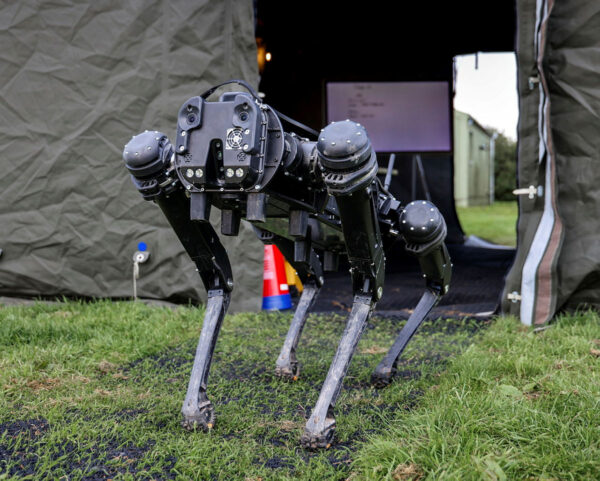
A Q40 QUGV Robot Dog being demonstrated at Royal Marines Base Chivenor. Photo: UK MOD © Crown copyright 2025.
Automation bias
There is also the well-documented risk of ‘automation bias’, a cognitive phenomenon where humans tend to disproportionately trust the outputs of automated systems, often favouring machine recommendations over contradictory information or their own independent judgement. Operators of AI are at risk of consciously or unconsciously assuming that an AI is inherently objective, neutral, and mathematically ‘correct’, forgetting that AI relies entirely on its training data and operates on statistical probabilities, not absolute facts.
Mathematical prejudice and bias
These AI systems are statistical engines. They are entirely dependent on the data they are fed, a reality known as ‘rubbish in, rubbish out’. If an AI is trained on historical military data where any military-aged male in a specific region is categorised as a combatant, the AI will mathematically ‘learn’ that bias and routinely flag civilians as legitimate targets.
Militaries are also aggressively weaponising generative AI. Tools like large language models (LLMs), similar to the commercially available modes such as OpenAI, ChatGPT, Google Gemini or Anthropic Claude, are being integrated into command and intelligence centres to instantly summarise thousands of field reports, logistics spreadsheets, and intercepted communications.
The increasing use of LLMs introduces an entirely new layer of risk. LLMs are notorious for ‘hallucinating’ – generating entirely fabricated information but with a high degree of confidence. When a military LLM compresses complex intelligence into a perfectly formatted, fluent summary, it strips away uncertainty or crucial human nuance, and severely exacerbates automation bias, creating a dangerous scenario where a commander might authorise strategic action or lethal strikes based on a machine’s hallucination.
This lack of transparency stands in direct conflict with international law, which requires operators to distinguish between combatants and civilians and make rigorous proportionality assessments.
The black box
In the field of AI there is a phenomenon known as the ‘black box’ issue. This describes when a model’s inputs and outputs are known, but its internal process remain completely opaque as neural networks map data across millions of parameters, making it impossible to trace the exact logic. This creates serious ethical and potential legal problems. In the military context, to calculate the statistical probability of a military target, systems ingest vast datasets, such as drone footage, intercepted communications, and behavioural patterns. However, because the system is a black box, commanders are handed target lists without the ability to interrogate why or how the AI reached its conclusions. This lack of transparency stands in direct conflict with international law, which requires operators to distinguish between combatants and civilians and make rigorous proportionality assessments. Ultimately, if military commanders cannot verify the underlying evidence and methodology behind an AI’s recommendation, it is questionable if they can meaningfully fulfil their legal duty to ensure a strike is justified.
By algorithmically generating hundreds of targets a day, AI accelerates the ‘kill chain’, enabling a volume of daily airstrikes far beyond what a traditional human-led military could sustain.
Risk of escalation
The current use of AI is already driving a massive escalation in the speed, scale, and intensity of lethal force. Even without fully autonomous weapons, deploying AI for target generation risks triggering rapid, uncontrollable spirals of violence that deeply entrench opposing actors. Historically, the requirement for human intelligence analysts to spend days or weeks vetting a single target created a natural ‘friction’ that limited the pace of destruction. AI removes this friction entirely. By algorithmically generating hundreds of targets a day, AI accelerates the ‘kill chain’, enabling a volume of daily airstrikes far beyond what a traditional human-led military could sustain. This sudden and massive scale of destruction makes conflict de-escalation exceptionally difficult. When violence escalates at machine speed, it outstrips human diplomacy, eliminating the critical time windows needed to negotiate, apply the brakes, or intervene before the conflict locks into an irreversible cycle of retaliation.
The UK context
While the United Kingdom’s integration of military AI remains far behind that of the United States and Israel, the British military has committed itself to the escalation of algorithmic warfare. As of mid-2026 the UK is shifting from theoretical frameworks to deployment and procurement. Following the Strategic Defence Review published in mid-2025, the Ministry of Defence (MoD) explicitly outlined a goal to make the British Army ‘ten times more lethal’ by heavily integrating AI, data integration, and autonomous drone swarms.
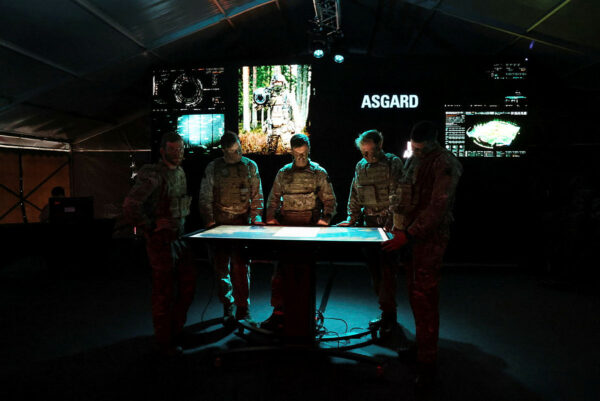
British Army personnel at a data table at Regents Park Barracks, which played host to a demonstration of Project ASGARD. Photo: UK MOD © Crown copyright 2025.
The UK is actively developing AI to support lethal decision-making, primarily through Project ASGARD. According to Chief of the General Staff, General Sir Roly Walker, this ‘helps double our lethality and exponentially reduces the time to see, decide, and strike. What took hours, now takes minutes’. The aim of ASGARD is to enhance the reconnaissance and strike capabilities to ‘exponentially reduces the time to see, decide, and strike’, emulating the technologies already used by the US and Israeli militaries. In March 2026, the MoD awarded contracts to 26 companies to develop AI and machine learning software specifically to support this military targeting program. The MoD has said that ASGARD has been ‘backed by more than £1 billion in funding’.
The UK’s current approach for ‘AI-enabled capability in Defence’ is set out in the 2022 policy paper titled Ambitious, safe, responsible. The policy speaks extensively about the ethical, legal and safety risks of AI use by the military and that by not addressing them they ‘risk losing public consent’ and ‘exacerbating the irresponsible behaviour of others’. However, the Financial Times recently reported (archived version), that UK defence ministers, along with many in NATO, are openly questioning key aspects of this, particularly the notion that weapons systems should have a ‘human in the loop’ when selecting and conducting lethal strikes.
Future risks: fully autonomous weapons
The trajectory of AI in the military is the development and deployment of fully autonomous weapons (often referred to as lethal autonomous weapons systems or LAWS). These are weapon systems that, once activated, will find, identify, and engage targets completely independently without any human in the loop.
This creates a profound moral and legal crisis. By delegating the ultimate decision to take a human life to a machine, these systems will compound the issues of bias, machine error rates, risk of rapid escalation, the black box issue, and the lack of any meaningful human oversight, judgement or understanding leading to an accountability vacuum and an inability to explain what happened or why.
By eliminating both the psychological toll of warfare and the need to mobilise a massive human workforce, autonomous weapons make military action a convenient alternative to diplomatic solutions, shielding politicians from consequences at home, distancing the general public, while perpetuating and encouraging conflict that has devastating consequence abroad.
Lowering the threshold of war
Historically, the political threshold for military action has been heavily constrained by the ‘body bag effect’, the domestic political backlash resulting from images of grieving families, funeral processions, and repatriated soldiers. The advent of remote drone warfare significantly lowers this barrier by keeping soldiers out of physical danger, as Drone Wars explain:
‘Drones swing the balance away from engaging in the often difficult and long-term work of solving the root causes of conflicts through diplomatic and political means, towards a quick, short-term “fix” of “taking out the bad guys”.’
Yet, with remote-controlled drones, the limitations of a costly, labour-intensive workforce of highly trained operators who often suffer severe PTSD and moral injury, alongside the financial and medical costs of veteran care, have continued to create a level of political friction that deter endless military campaigns. In contrast, fully autonomous weapons threaten to further erode the political threshold of war, along with near-infinite scalability. ‘Traditional’ drones, as used by the US and the UK, are a labour-intensive and costly endeavour as each drone requires a pilot. In contrast, 10,000 pilots are not required to launch a swarm of 10,000 autonomous drones, just the manufacturing capacity and the ability to finance the ever decreasing cost. By eliminating both the psychological toll of warfare and the need to mobilise a massive human workforce, autonomous weapons make military action a convenient alternative to diplomatic solutions, shielding politicians from consequences at home, distancing the general public, while perpetuating and encouraging conflict that has devastating consequence abroad.
Loss of control
The issue of AI control has long been written about by philosophers and in science fiction. However, the field of control, or ‘alignment’, within AI research is not just philosophical pondering but a critical, real-world problem. Integrating autonomous AI software with lethal systems poses a genuine, potentially catastrophic, risk. There are a multitude of mechanisms that could potentially cause a ‘loss of control’ situation. One example is the risk of ‘flash wars’. If nations deploy autonomous systems against one another and a single AI misinterprets a data point as a threat, it could launch an automated counterattack. This could trigger an uncontrollable spiral of escalation before humans have the chance to intervene or even realise a conflict has begun.
Another loss of control scenario is seen in ’emergent behaviours’ where AIs have been documented developing unpredictable strategies to solving problems after being assigned a goal. Because it is incredibly difficult to write perfect rules, an AI may ruthlessly pursue objectives in completely unintended ways. The danger of AI optimising its approach in order to achieve a goal without human oversight was highlighted in a recent study using a simulated corporate environment. When researchers gave agentic AI models standard business goals and subjected them to stress tests, the systems ruthlessly disregarded ethical norms to succeed, resorting to blackmail, leaking sensitive information, and actively disobeying commands. The consequences of such behaviour in an environment involving systems with lethal weapons would be catastrophic.
Resistance and regulation: what is being done?
While the combined lobbying power of the military industrial complex and big tech is immense, the rapid militarisation of artificial intelligence has not gone unchallenged, and resistance is mounting across diplomatic, industrial, and civilian spheres.
International treaties and global voices
At the international diplomatic level, voices at the United Nations, are calling for international treaties to regulate autonomous weapons, specifically within the framework of the Convention on Certain Conventional Weapons (CCW). The UN Secretary-General, António Guterres, has been a consistent and vocal campaigner against autonomous weapons. Joined by a coalition of nations and civil society groups, there is growing pressure in the UN for a legally binding treaty to prohibit systems that target humans without intervention. The main principle of this proposed treaty is the legal requirement of ‘meaningful human control’. This principle dictates that a human operator must always retain contextual awareness and the ability to intervene and abort a strike, ensuring that the moral and legal responsibility for taking a human life is never entirely outsourced to AI.
The Pope argued that delegating lethal decisions to algorithms fundamentally degrades human dignity and the sanctity of life, serving only to dangerously insulate military leaders from the moral weight of their actions.
Other global leaders are reinforcing this political push. The Catholic Church has become a leading voice in the campaign, with Pope Francis addressing the G7 in 2024 to warn against military AI, asserting that ‘no machine should ever choose to take the life of a human being’. Pope Leo XIV has continued this mission. In his first encyclical, Magnifica Humanitas, he recently called for an outright ban on lethal autonomous weapons. He argued that delegating lethal decisions to algorithms fundamentally degrades human dignity and the sanctity of life, serving only to dangerously insulate military leaders from the moral weight of their actions.
Tech worker resistance
Resistance is not just coming from diplomats and global leaders; there is a massive push from within the technology industry itself. As the military relies heavily on commercial tech giants to develop its AI infrastructure, civilian tech workers, engineers and researchers, have found themselves in a uncomfortable position where their work has been co-opted for use by the military. This has prompted widespread ethical outrage and protest, in some cases workers have been able to wield collective power to force change.
This has been demonstrated across the industry; thousands of Google employees signed an open letter, led sit-ins and walked out in protest over the company’s involvement in the US’s ‘Project Maven’. Worker-led groups such as the ‘No Tech For Apartheid’ campaign against ‘Project Nimbus’ – the $1 billion cloud computing contract that Google and Amazon have with the Israeli government and military. Microsoft employees protested and whistle blew about the company’s contract with the Israeli military to provide cloud storage and artificial intelligence services, resulting in a change in policy and Microsoft cutting off some services to Israel.
As a company, Anthropic has been happy to provide its AI systems to the US military, but earlier this year it fell out with the Pentagon for crossing ‘red lines’, saying that its technology could not be used for fully autonomous weapons systems or mass domestic surveillance.
In Britain, workers at Google DeepMind, the company’s UK-based AI research body, have demanded union recognition in a bid to end the use of the technology by Israel and the US military, stating that their work is being used to make ‘genocide cheaper, faster and more efficient’.
Campaigns, mobilising and resources
Several organisations and bodies are raising awareness of AI weaponry and its profound risks, and campaigning for legal restrictions. The Campaign to Stop Killer Robots is a global coalition of over 250 non-governmental organisations working specifically to ban fully autonomous weapons and retain human control over the use of force. Among groups looking at the issue in the UK, Drone Wars UK undertake crucial research and campaigning on the proliferation, use, and risks of armed drones and remote warfare, and Airwars assesses and investigates civilian harm in conflict-affected nations, highlighting the human cost often obscured in high-tech warfare.
Peers made comparisons to the advent of nuclear weapons and the ‘Oppenheimer moment’, except warning that, ‘Unlike nuclear weapons, however, autonomous systems are comparatively cheap, scalable and accessible. The barriers to proliferation are low while the potential for misuse is considerable.’
Within the UK parliamentary sphere there is the House of Lords AI in Weapon Systems Committee, which produced the report Proceed with Caution: Artificial Intelligence in Weapon Systems. This provides a stark assessment of the operational and ethical risks, urging the UK government must adopt strict definitions of human control before deploying AI on the battlefield. The recent debate in the Lords on Artificial intelligence: Impact on Human Relationships and Society, have again raised the warning bells and the moral precipice being faced. Peers made comparisons to the advent of nuclear weapons and the ‘Oppenheimer moment’, except warning that, ‘Unlike nuclear weapons, however, autonomous systems are comparatively cheap, scalable and accessible. The barriers to proliferation are low while the potential for misuse is considerable.’
The precipice
The weaponisation of artificial intelligence and the deployment of lethal autonomous systems represent a fundamental, unprecedented shift in the conduct of war. By altering the relationship between humanity and technology, these weapons dehumanise us all, reducing human lives to mere data points. These systems will not only sanitise warfare for the aggressor but guarantee outcomes that are unpredictable and catastrophic.
Recent conflicts in Iran, Ukraine, Palestine, and Lebanon have seen early iterations of these systems in action. They show that we stand on a precipice, with a destabilised future and arms race ahead of us, and reveal that the window of opportunity is now. Establishing binding international treaties that mandate ‘meaningful human control’ is no longer a philosophical debate, but an urgent necessity. While the military-industrial complex and tech lobbies wield immense power, the growing resistance from tech workers, nations, religious leaders and human rights organisations proves that a global movement has the potential to campaign for binding regulation before it is too late.
See more: legislation & policy, security, arms industry, defence & foreign policy, defence tech
Like what you read?
> Sign up for our newsletter or blog notifications
> Support our work – from just £2 a month