Training school pupils for the military and surveillance?
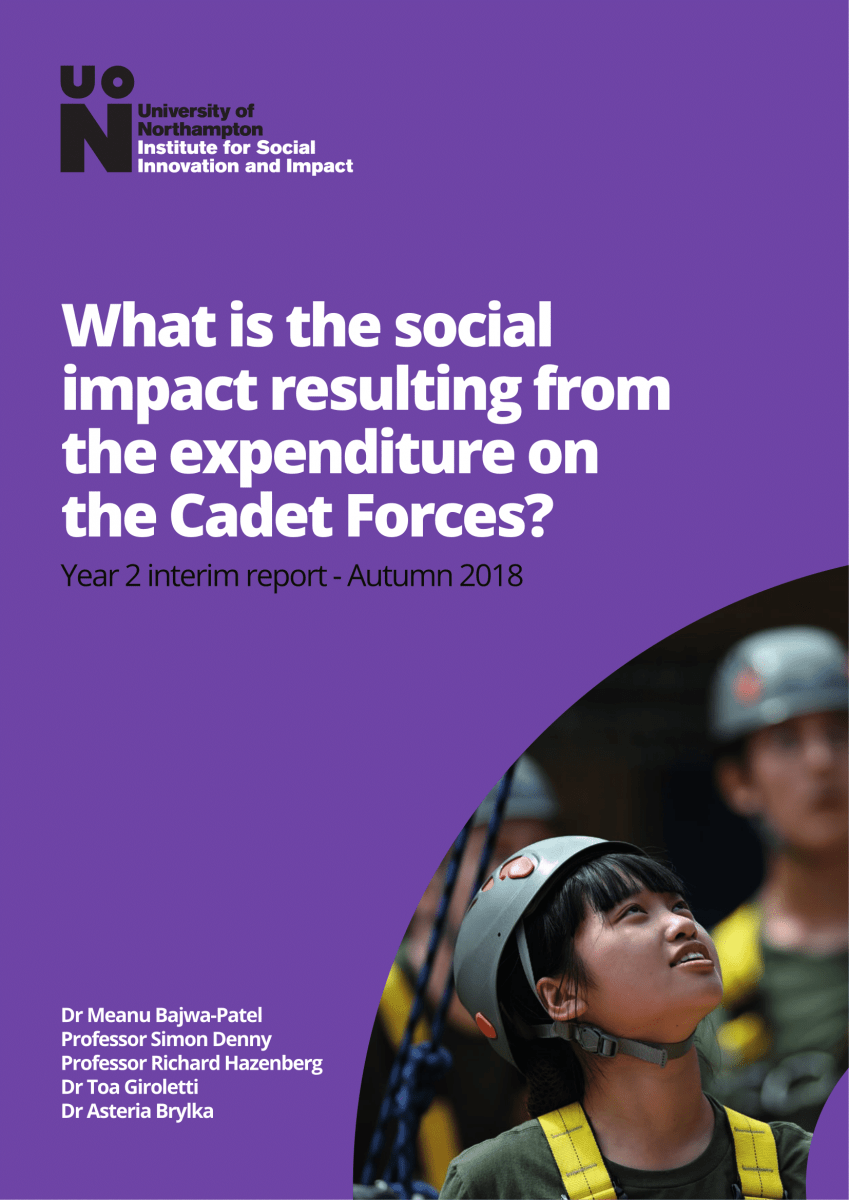
Over the last two weeks the MoD has made various announcements relating to armed forces cadets. These include 30 new cadet units in schools, referring to a new social impact report, and the extension of the Cadet Expansion Programme with cadet numbers in schools rising to 60,000 by 2024. They also unveiled a new Cyber Cadet scheme and a National Cadet Week.

Previous high profile announcements have surrounded this part of the ‘military ethos’ programme, indicating the status that the government are giving it. The driving factors are an ideological belief in the power of cadets, and the military, to transform young people’s lives, and the need to generate new recruits in the midst of a recruitment crisis. Given Gavin Williamson’s penchant for taking things further than other defence secretaries, this raft of new measures is not surprising.

As our partner organisation Quakers in Britain note, advice given to ministers in how to deal with press questions at the Conservative party conference shows the government is aware of public unease about militarism in schools which ‘expose(s) children to militarism without any exploration of the morality or danger of war.’

… Read more

Bodyguard gets it wrong

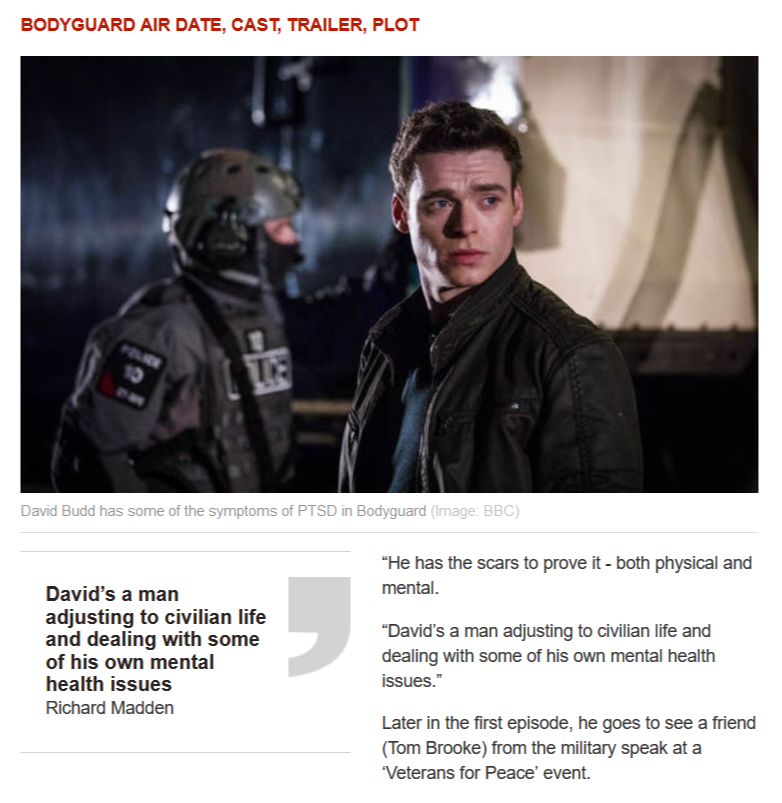
The recent BBC drama Bodyguard, featuring a ‘troubled veteran’ recently captivated on average 10.4 million viewers, reaching a peak of 11 million as it ended. It is the BBC’s most watched drama since 2008.

While there has been some important debate around Islamophobia and Bodyguard, given the way in which the series depicts a female hijab-wearing suicide bomber, there are also concerns about its portrayal of veterans, militarism and security.

One of the media articles about Bodyguard that mis-named the fictional veterans group, calling it by the name of the real-life group Veterans for Peace.

The hero, David Budd, is a veteran. He is from the outset clearly disillusioned with the war on terror, suffers from PTSD and resents those who sent him and others to war. He now works for the police force. One of the earliest, most gripping scenes sees him trying to talk to a jihadi suicide bomber and persuade her not to detonate. He says to her:  

‘You’ve been brainwashed. He has. [referring to her husband] You have. And I know. I was in Afghanistan. I saw mates get killed. Nearly got killed myself. For what? Nothing. Politicians. Cowards and liars. Ours and theirs. People full of talk but will never spill a drop of their own blood.… Read more

Recruitment at any price

The Public Accounts Committee have today published their report Skill Shortages in the Armed Forces. The report is narrowly focused on how to solve the problem of the recruitment shortfall and it makes a number of problematic recommendations that put the military’s operational needs over other considerations.

There is an implicit suggestion in the report that the ‘recruitment crisis’ can be solved if only the MoD reached out far enough and strategise better. This does not recognise societal changes, particularly amongst young people, that make the armed forces, with all its attendant risks, obligations and ethical considerations, an unattractive career for many.

The report shows little in-depth consideration of the methods of recruitment and gives no space to the ethics of how young people are marketed to, and recruited into, what is a career with unique risks and moral implications. Very disappointingly, it suggests even more marketing and STEM activities in schools.

‘Innovative approaches to recruiting’ will undoubtedly mean that the armed forces will seek to use other education and youth organisations as a channel for building interest. Another recent report on the ‘recruitment crisis’ also suggested ‘innovative’ ways of interesting young people such as putting the armed forces onto the curriculum and actively encouraging cadets to enlist into a forces career.… Read more

Notes on attending the inquest into Sean Benton’s death at Deepcut barracks

Download the full notes

It was only on certain days of the inquest – for example, when Sergeant Andrew Gavaghan took the stand, and for the verdict, that the small room at Woking Coroner’s Court was full. On most days, other than lawyers for Sean’s family, for the Ministry of Defence and for Surrey Police, there were few attendees: members of Sean’s family, their legal representatives from Liberty, an independent journalist dedicated to covering Deepcut, and the mother of Geoff Gray, another young person who died there.

Diane Gray was there without fail, listening like the Coroner to evidence from former Deepcut recruits and military personnel who knew Sean. The inquest into her own son’s death will begin next year; the second pre-inquest hearing also took place last week.

Speaking with Diane showed her to be a person with an extraordinary capacity for strength and resilience, fighting to get justice for her son and for others who suffered like him. There was frustration from years of fighting, the failure to get a jury, and the disappointing probability that the inquests will not go to a criminal court. The overwhelming sense was of the exceptionalism of the military with regards to justice and human rights, the feeling of powerlessness and the immense impact of the Deepcut abuse and deaths on individuals and families.… Read more

Deepcut – another verdict; still more questions….

Today is a significant day in the Deepcut tragedy – when a family affected by the loss of their child during training at the army barracks may finally get some sense of understanding and justice after many years of battling against the military’s lack of accountability. Attending the inquest it becomes rapidly clear that the army has all the resources on its side and that the Benton family has been up against a culture of secrecy from various authorities.

Two years ago the second inquest into Cheryl James’ death delivered a verdict of suicide. While very disappointing for the James family, the coroner did also make extensive comment on the toxic environment at Deepcut and the serious failures in duty of care by the chain of command.

Today, a similar verdict has just been announced in the case of Private Sean Benton, who died aged 20 from gunshot wounds to the chest. News just in indicates that the family will be formally requesting that the police open a criminal investigation. We were at the hearing and will have a full report in due course. See our twitter feed.

The two inquests and two BBC documentaries that followed the verdict in 2016 have brought to light the accounts of many current and former soldiers who claim to have suffered physical violence and/or sexual abuse at the camp.… Read more

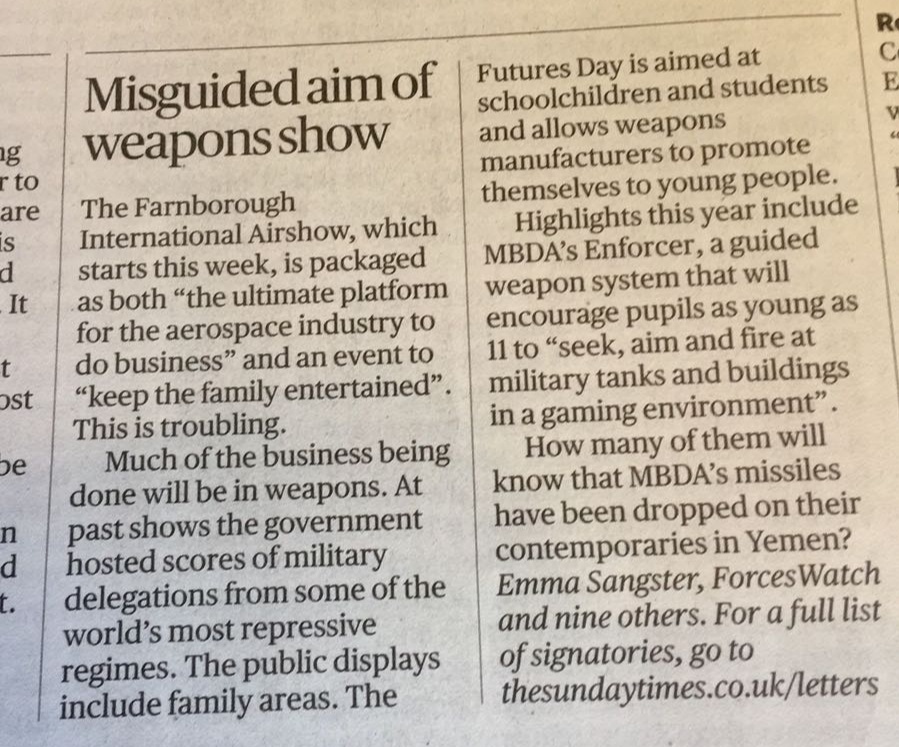
Misguided aim of weapons show

The packaging of Farnborough International Airshow as both ‘the ultimate platform for the aerospace industry to do business’ and an event to ‘keep the whole family entertained’ is troubling.

Much of the business being done will be in weapons. All top ten global arms companies will be present.

At past airshows the Government hosted scores of military delegations from some of the world’s most repressive regimes.

The public displays include flypasts, exhibitions and family areas.

The Futures Day is aimed at school and university students and allows weapons manufacturers to promote themselves to young people through STEM activities.

Highlights this year include MBDA’s The Enforcer which will encourage school pupils as young as 11 to ‘seek, aim and fire at military tanks and buildings in a gaming environment’. How many of them will know that MBDA’s missiles have been dropped on their contemporaries in Yemen?

Unfortunately, this is but one example of the numerous ways in which military interests are increasingly allowed to influence young people under the guise of education.

A more ethical approach would be to engage young people’s interests in how science, design and technology can contribute to sustainable peace, healthcare, social justice, and environmental sustainability.

Emma Sangster, Coordinator, ForcesWatch
Celia McKeon, Coordinator, Rethinking Security
Mark Curtis, Author
Dr Stuart Parkinson, Executive Director, Scientists for Global Responsibility
Rowan Kinchin, Coordinator, Campaign Against Arms Trade
Jon Nott, General Secretary, Woodcraft Folk
Sophie Neuberg, Executive Director, Medact
Paul Parker, Recording Clerk for Quakers in Britain
Pat Gaffney, General Secretary, Pax Christi
Oliver Robertson, Development Manager, Fellowship of Reconciliation

Notes

See the Futures Day programme and also see the list of exhibitors in the Innovation Zone – ‘a focal point for Futures Day – the industry’s single largest STEM (Science, Technology, Engineering, Maths) outreach activity, attracting the next generation of scientists and engineers who will drive our sectors forward into the future’.… Read more

The concerted effort to increase the power of the military across society must be challenged

As support for the military is paraded in streets across the UK at Armed Forces Day events, politicians charged with fighting the military’s corner are waging their own war on public and political opinion.

The public row between Defence Secretary Gavin Williamson and Downing Street over defence spending has caused many to question his political judgement but his calls have been backed by other parts of the defence establishment. The House of Commons Defence Committee last week pre-empted the Modernising Defence report of inquiry due next month with a demand for ‘beyond 2%’.

Williamson’s unwillingness to wait for that report is partly because the UK’s contributions to global defence objectives will be discussed at the NATO summit in July. Donald Trump’s repeated ‘requests’ for hundreds more British troops in Afghanistan is also likely to be on the agenda.

The government is reported to be reluctant to capitulate to these demands. Chancellor Philip Hammond is said to have told ministers that with further money needed for the NHS, the budget cannot withstand increased spending on defence.

Williamson has threatened to bring Theresa May down if defence does not get an extra £20 billion.… Read more

Warrior Nation – ‘the hidden power of the military’

Written by leading defence academic Paul Dixon, of Birkbeck, University of London and published in the run up to Armed Forces Day on 30 June, the study considers how a ‘militarisation offensive’ has increased the military’s influence on British politics and society in recent years.

Speaking during the launch at Friends House in London Paul Dixon explained that the Armed Forces Covenant – a moral contract between British society and the military – was ‘an invention by the military in the year 2000’, which has since been used to promote military interests in wider society such as support for the Afghan war from 2006.

The study looks at how the military actively pushed for escalation of Britain’s involvement in the wars in Iraq and Afghanistan but then deflected responsibility for their failures onto politicians.

It focuses on how successive governments have struggled to contain the power of the military and how senior military figures have broken with convention to publicly criticise politicians – and in particular Jeremy Corbyn, since his election as leader of the Labour Party.

Paul pointed out that under Corbyn Labour has now committed to a 2% target on defence spending, but said that ‘having achieved that the next goal (for the military and its supporters) is to push it up to three per cent.’… Read more

War Hurts Everybody

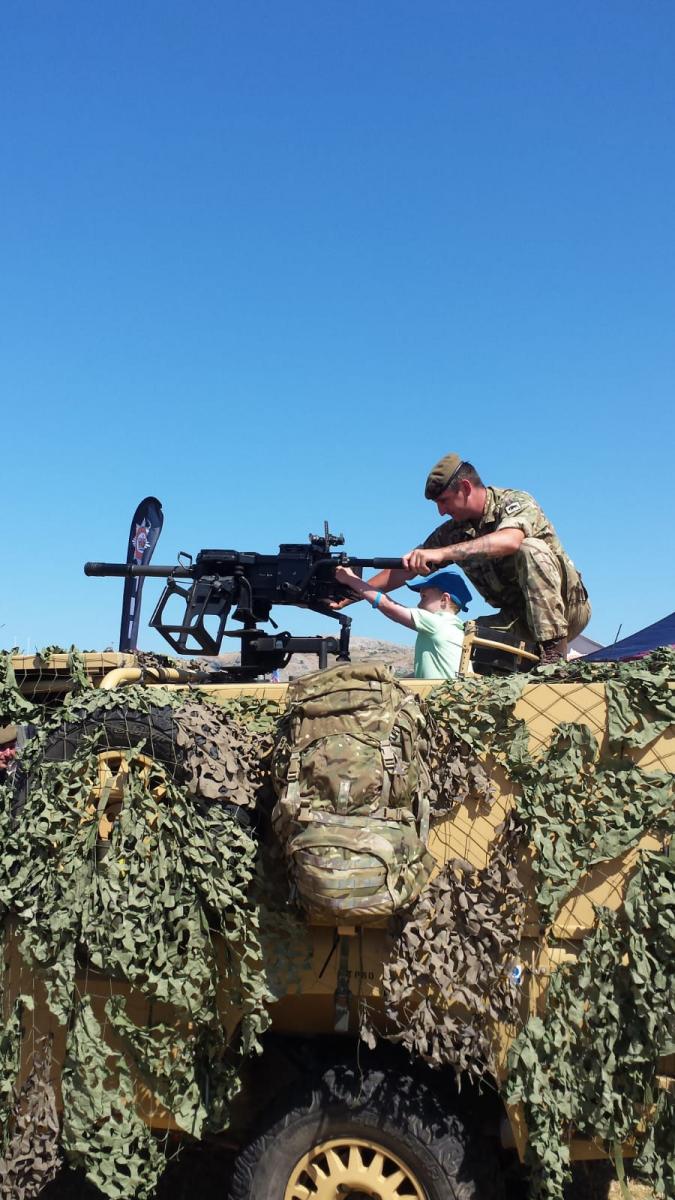
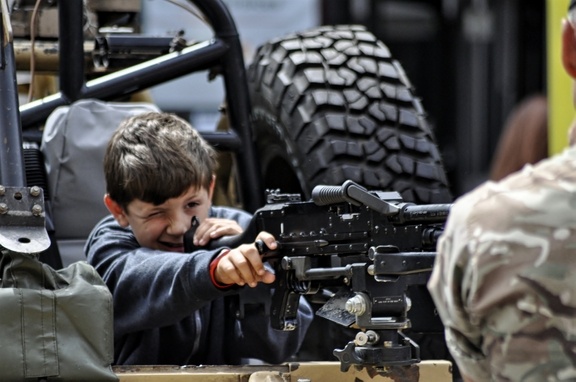
Young children were being encouraged to handle the weapons, despite the Mayor’s previous assurances that this would stop. While many passers-by thanked them for being there, the Army asked the police to stop them photographing the recruitment display.

This year in Leicester Armed Forces Day was 23 June whereas in most other places it will be 30 June. Those of us concerned about these public displays and the militarisation of young people had received assurances from our City Mayor that children would not be allowed to handle guns at these events (see details here). and so a group of us spent two hours in the city centre at the display of weapons and big trucks and recruitment games.

Seventeen of us held a silent vigil facing the army in a long line, some holding the Peace Pledge Union cards which said ‘War is not Family Entertainment.’ Some held a Quaker banner. On a table in the middle a large placard said ‘War Hurts Everybody’.

We also had beforeyousignup cards on the table and other information about under-18 recruitment.

Many passers-by thanked us for being there.

Meanwhile we had someone taking photographs of what the armed forces were doing, especially when they allowed children to handle the guns.… Read more

The armed forces and special schools

Their piece, Army recruiters accused of targeting vulnerable children at Scottish special schools, is based on research we did on visits to special schools over recent years: ‘In 2016-17 alone, there were six visits by forces personnel to special schools around Scotland. The schools included Edinburgh’s Gorgie Mills School, Willowbank School, ­Coatbridge, Kear Campus in Blantyre and Westmuir High School, Glasgow.’

The question is why such a massive remit would be given to an organisation whose primary purpose is defence rather than educational, if no ­recruitment outcome was expected?

While giving evidence to the ­petitions committee, the Army confirmed they “support” schools with special needs, along with other schools: the Army’s aim, is ‘to support all schools, whether independent, state sector or special needs and regardless of postcode area.’ As we said to the committee in our submission: the question is why such a massive remit would be given to an organisation whose primary purpose is defence rather than educational, if no ­recruitment outcome was expected?

We commented that: ‘We feel that it is unacceptable for the Army to visit special schools and primary schools, as younger pupils and those with additional needs are particularly vulnerable to ­sophisticated marketing messages.… Read more