
education materials
education materials
Robot dogs in UK schools: good dog or bad dog?

Investigate why robot dogs are visiting schools across the UK with the STEM Detective! This year's BAE Systems STEM Education Roadshow is running school workshops about artificial intelligence with a robot dog named Lexi. But, while pupils get to make music videos with Lexi, robot dogs have other functions on the battlefield.
Teach Peace Secondary
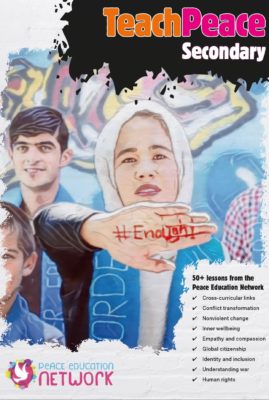
The Peace Education Network'sTeach Peace Secondary offers over 50 cross-curricular lessons from a range of organisations including Pax Christi, Amnesty International, Values Based Education, Scientists for Global Responsibility, Facing History & Ourselves, Corrymeela, and War Child. Lessons are freely available via TES.com and include:
- Amnesty International: How does the arms trade work?
- Scientists for Global Responsibility: A beginner's guide to nuclear weapons
- Pax Christi: Military spending – does it make us more secure?
- Conflict Resolution in Sheffield Schools Training (CRESST): Curious about conflict
Responding to military engagement in schools
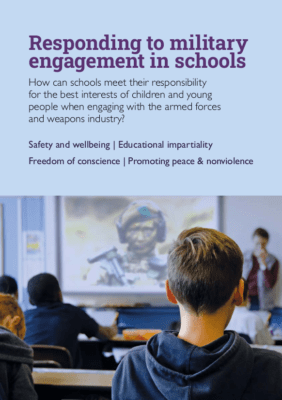
This booklet produced by Quakers in Britain in 2022 asks how can schools meet their responsibility for the best interests of children and young people when engaging with the armed forces and weapons industry? It provides information, resources and ideas for countering military influence in schools.
Animated poem about the military recruitment of young people
A spoken work poem by artist Potent Whisper, animator Neda Ahmadi, and sound designers Torch & Compass on the military recruitment of young people. See more from CRIN on Should the armed forces recruit children under the age of 18? including a comparison to a recent army recruitment advert and a learning resource from the Quakers in Britain peace education team, to encourage critical thinking about armed forces recruitment and its relationship to human rights.
Planning Remembrance Day events in your school
This guidance is based on five-years of research carried out by Oxford Brookes University and Brunel University London. It looks at how school leaders can approach discussing ethical themes related to conflict.
White Poppies for Schools
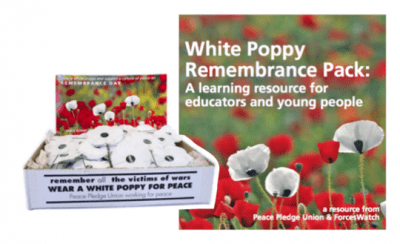
We have teamed up with the Peace Pledge Union to produce a White Poppy Schools Pack, which aims to explore Remembrance in a way that encourages critical thinking, and gives space for marginalised perspectives on war and peace. The learning resource can be read online here, or purchased from the Peace Pledge Union as a bigger pack including white poppies and white poppy leaflets.
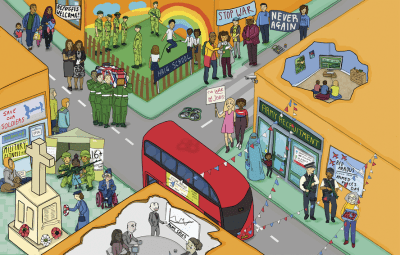
Everyday Militarism poster
The new tide of militarisation
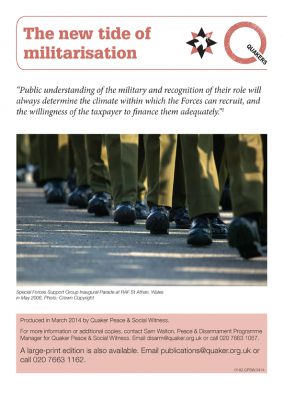
Militarism has existed in the Britain for a long time, but there is a new tide of militarisation that has developed over the last five years. This briefing from Quaker Peace and Social Witness, explores the government strategy to increase public support for the military, in order to raise the willingness of the public to pay for the military, make recruitment easier, and stifle opposition to unpopular wars.
Answering difficult questions about militarism
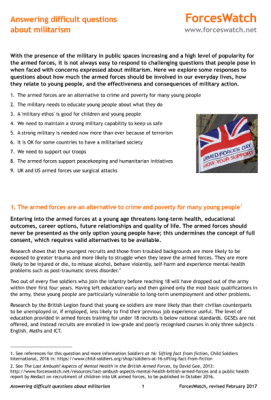
With the presence of the military in public spaces increasing and a high level of popularity for the armed forces, it is not always easy to respond to challenging questions that people pose in when faced with concerns expressed about militarism. In this briefing we explore some responses to questions about how much the armed forces should be involved in our everyday lives, how they relate to young people, and the effectiveness and consequences of military action.
Science for Society

Science4Society is a collection of science education activities, which focus on the contribution that science, design and technology can make to peace, social justice and environmental sustainability. The project was set up to provide an alternative to activities funded by the arms and fossil fuel industries and is co-ordinated by Scientists for Global Responsibility.