Roadshows, robot dogs and fairytales: How Britain’s largest weapons company targets schools

‘Thank you to the team from the STEM Roadshow […] for delivering such a memorable event and providing an insight into the types of opportunities available to pupils who want to pursue careers in Science Technology and Maths (STEM).’
This was the feedback one school shared on their website after their year 7 class was visited by BAE System’s STEM (Science Technology Engineering and Maths) education roadshow in April of last year. The class had taken part in an AI workshop, created their own music video and even played with a robotic dog called Lexi.
The STEM roadshow, which has partnered with the RAF from 2008 and the Royal Navy from 2015, has been running for 20 years. During this time it has become a fixture in the calendars of at least 500 schools across the country.
BAE Systems claim the event’s ‘awe inspiring assemblies’on topics such as electricity, space travel and robotics have played ‘an important role in inspiring the next generation of innovators, aviators and engineers’.
Who are BAE Systems and what is their involvement in education?
With around 35,000 staff and now making record profits exceeding £3 billion last year, BAE Systems is Britain’s largest defence contractor but also operates globally. The company produces a range of military equipment, including fighter jets, armoured vehicles, warships and submarines, missiles and guns, and cyber and intelligence technology.
BAE Systems have spent over £1 billion on skills and education in the last five years.
BAE’s most publicised educational intervention is its STEM education roadshow, a spectacle-led presentation which has featured elements such as a robot dog, lightsabre battles, and presenters with names such as Mr Magnetic introducing students to BAE Systems, the RAF and Royal Navy.
However, the company’s involvement in education is wide ranging and extensive, from BAE employees sitting on the governing body of the Furness Academy Trust in one of the company’s main employment locations in Cumbria, to the development of educational resources for children from the ages of five to sixteen. BAE Systems have spent over £1 billion on skills and education in the last five years.
Why education?
BAE Systems are not the only arms manufacturer present in UK schools, as many of the largest companies in the industry have for some time been involved in STEM education and the sponsorship of schools which are focused towards STEM such as University Technical Colleges. However, from engineering fairytales to detailed lesson plans, BAE’s presence in British education is perhaps the most pervasive.
Using a veneer of engineering and innovation, the company’s involvement in education often not only obscures their role in war but actually presents the company as a benevolent business.
This presence has allowed them to boost brand recognition, create interest among – and recruit – future workers, and influence the curriculum in a way that sanitises their public image in the minds of school children. Using a veneer of engineering and innovation, the company’s involvement in education often not only obscures their role in war but actually presents the company as a benevolent business.
As well as producing their own materials for use in education BAE Systems has worked with or sponsored STEM organisations and has over 1000 STEM Ambassadors offering outreach activities to schools. They are also involved with STEM education through the resources and activities developed by engineering organisations. Along with the RAF and arms companies Rolls Royce, Leonardo and MBDA, they are part of Team Tempest – developing a ‘new generation’ of fighter jets – which produced the Future of Flight learning resource with the Royal Academy of Engineering. Also with the RAF, they sponsor the Smallpiece Trust’s Coding Success programme which visited over 200 schools last year.
Why has the UK’s largest arms company been bringing a robot dog to UK schools?
Utilising sustainability
A learning resource called ‘Stratospheric STEM’ was developed by BAE Systems and STEMFirst – part of the STEM Ambassadors network – in 2021 (see archived version). The resource described the BAE as a designer of ‘innovative systems and solutions’ and a company which helps protect not just people but ‘the planet as well’.
The resource introduced classes to an ‘incredible, light weight’ and ‘solar powered’ airplane, the PHASA-35. The students then had to decide where to place the solar aircraft in order to most effectively monitor the decay of polar ice caps, reduce wildfires, track meteor threats and address ocean pollution.
The lesson concluded with children pitching their proposals of how to ‘solve’ some of the world’s biggest problems to a fictional client, the ‘Global Environmental Monitoring Association’. Back in the real world the PHASA-35 has primarily been designed for military surveillance.
The Stratosperic STEM resource illustrates how BAE System’s educational outputs can be used to sanitise their image and distance themselves from warfare in the minds of educators as well as children. However, other resources appear to do the opposite and seem to have been designed with the purpose of normalising warfare in the classroom.
Promoting careers in the arms trade
This is evident in the ‘Find Out What You Could Become at BAE Systems’ booklets which are available to download from the company’s website and are designed for both primary and secondary school children. The primary school resource includes detailed photos of a Typhoon aircraft as well as several ‘fascinating facts’ about the jet, such as how it takes ‘8 seconds to take-off from standstill’ and then ‘reaches supersonic speed in under 30 seconds’.
The aircraft’s futuristic design and incredible speed are sure to spark the imagination of young children. Many will dream of flying planes which look like space ships, travelling at supersonic speeds and even helping to build similar machines in the future.
But would children feel the same way if they knew the Typhoon aircraft had been used in bombing campaigns during the Saudi-led war in Yemen? A war which, according to the Yemeni Data Project, resulted in the death of thousands of civilians and the destruction of homes, hospitals and schools. Amnesty International found evidence for numerous war crimes, including in 2018 when a Yemeni school bus was hit, killing 40 boys from the ages of six to eleven.
The Saudi connection
The ‘Find Out What You Could Become at BAE Systems’ booklet also introduces some of the company’s land vehicles, which it says can be used as ambulances or to rescue people. There is no mention of how BAE’s Tactica vehicle has been used by Saudi forces to repress pro-democracy protests in Bahrain.
Children, irrespective of age, deserve to know who the people speaking to them are, what products they make and who they sell them to.
Using fast planes and rescue vehicles to encourage students to connect to a company’s business is deceptive. Children, irrespective of age, deserve to know who the people speaking to them are, what products they make and who they sell them to.
BAE System’s educational resources do not invite students to consider the moral implications of supplying lethal weapons to governments investigated for war crimes. Nor do they ask children to question how they would feel if their labour had produced equipment which had been used to kill innocent people.
However, these are questions workers at BAE Systems must consider. Despite Saudi Arabia being on the British government’s human rights watch list, the country is BAE Systems’s third biggest customer. The relationship dates back to the 1970s and over the last decade alone, it is estimated Saudi Arabia has purchased more than £27 billion of military equipment from BAE.
‘Defence’ equipment has repeatedly been used to undermine the very same human rights the UK claims to uphold. Ignoring alleged crimes against humanity, and a range of other concerns such as death sentences handed out as a result of social media posts and the suppression of women’s rights, BAE justifies its sales to Saudi Arabia by declaring on its website that the country shares the UK’s ‘priorities … including trade and investment; energy and climate change; and defence and security’.
Israel and the F35
BAE Systems is also one of the UK’s most direct links to the genocide in Gaza. With the rear fuselage of the controversial F35 fighter jet produced in the company’s Lancashire factory. The jet’s primary manufacturer, Lockheed Martin, describes BAE as one of its two ‘principle industrial partners’.
The aircraft have been implicated in what the UN has called ‘indescriminate and disproportionate’ attacks by Israeli forces on civilians in Gaza including in July 2024 when it was used to drop three 2,000lb bombs on a designated ‘safe zone’ in Al-Mawasi, Southern Gaza, killing 90 people and injuring at least 300. It has also been used illegally in the occupied West Bank. A minimum of 45 F35 fighter jets have been delivered to Israel and further attacks using the jet have taken place in Lebanon, Syria, Yemen and Iran, with civilian targets being hit.
Whitewashing
BAE Systems are determined to improve their public image. Their website showcases a ‘Menopause Friendly Employer Award’ the company won in 2024 and a report titled ‘BAE Systems’ contribution to the UK’ highlights how 20% of the schools it supports are in lower socio-economic areas.
Recent sponsored articles focusing on BAE’s ‘inclusive workplace culture’ have appeared in Black British newspaper The Voice and the online publication Women in Tech, while their importance to the economy is self-promoted in The Sunday Times.
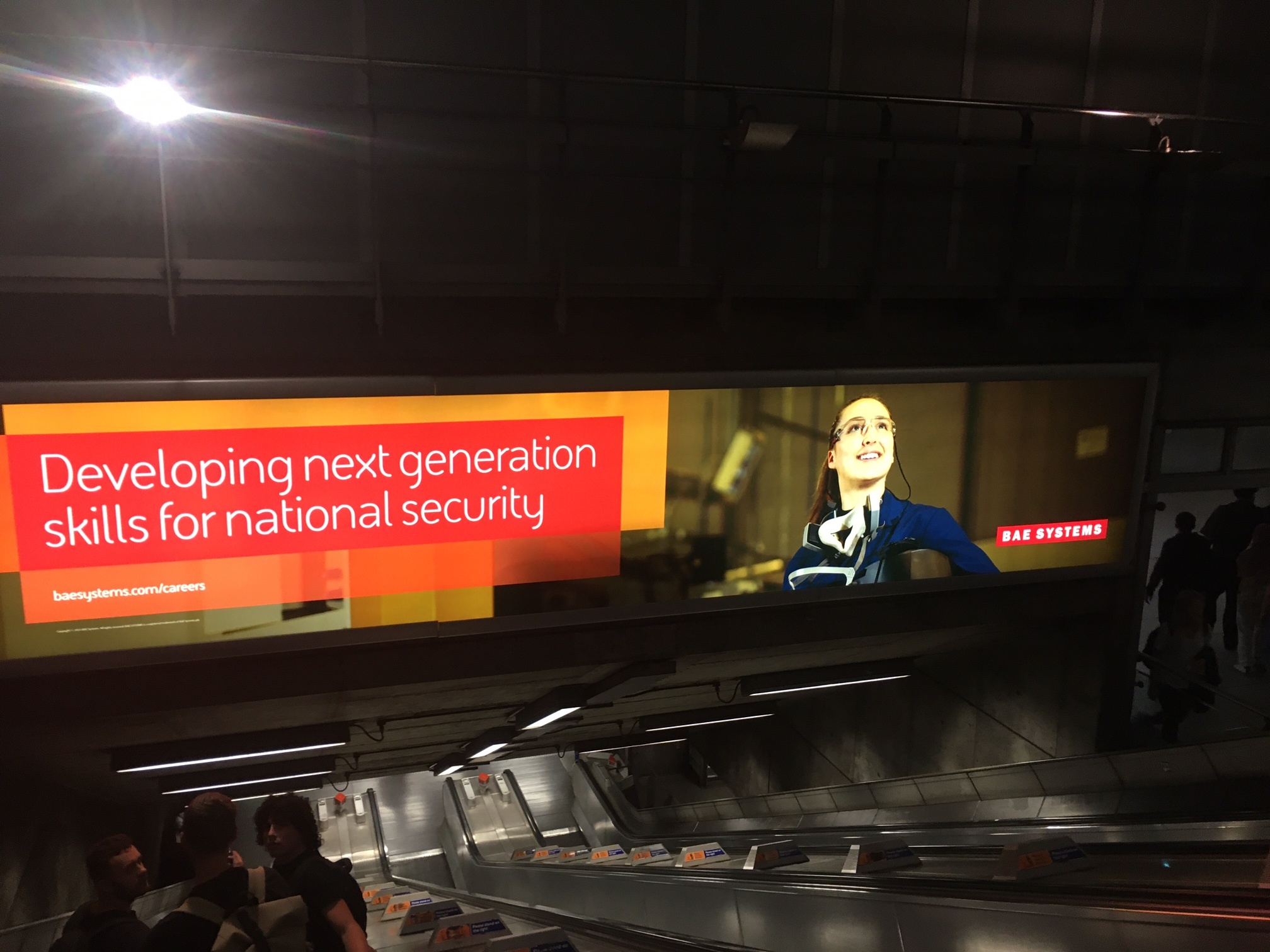
A BAE Systems advert about their education activities at Westminister underground station, July 2025. Photo: ForcesWatch
Along with other arms companies, BAE Systems also enjoys unparalleled access to the UK government, including holding more meetings with ministers than any other private company between 2012 and 2023. In a submission to an inquiry about the impact of Covid-19 on education and children’s services, BAE Systems stated that it ‘already works very closely with Government in this area and particularly with DfE [Department for Education] and enjoy a constructive dialogue with them’.
The RAF and the Royal Navy committed to further five years of funding for BAE System’s STEM roadshow in February 2025. This must be met with closer scrutiny on arms manufacturers’ presence in British education.
Financial power and political influence has allowed BAE Systems to develop a strong presence in British education – effectively distancing themselves from conflict, connecting themselves with innovation and technology, and perhaps most misleadingly portraying themselves as an agent of societal progress.
The RAF and the Royal Navy committed to further five years of funding for BAE System’s STEM roadshow in February 2025. This must be met with closer scrutiny on arms manufacturers’ presence in British education. BAE Systems make over 95% of their profits from the sale of military hardware and expect £30 billion worth of their products to be ordered this year.
They should not be given a platform to whitewash their brand, captivate young minds or dissociate from their role in conflicts around the world.
For 2026, the BAE Systems Education Roadshow is called ‘Material World – Engineering the Future’ and will be delivered to 8-14 year olds with hi-impact – an education technology company – and Altru Drama.
Read Michal’s recent article about arms companies in Bristol schools and how teachers are responding.
Watch our new video on the BAE Systems Education Roadshow.
See more: military in schools/colleges, STEM, arms industry, arms trade, education, ethics
Like what you read?
> Sign up for our newsletter or blog notifications
> Support our work – from just £2 a month