Facts or Anecdotes? The battle for the truth over the outcomes of military service
Every time new research speaks to the negative outcomes of military service a number of serving personnel and pro-military veterans – spontaneously or otherwise – take to social media to relate their own positive anecdotal experience. This was again the case with the recent Child Rights International Network report on the army’s targeting of recruitment towards young people from socially deprived backgrounds.

‘The army made a man out of me!’ is one common claim, alongside others like ‘I wouldn’t be where I am today without joining up” and “I’d be dead or in jail if not for the military.’

This last one deserves particular attention today following a report in the press on Sunday suggesting that veterans are the biggest occupational group in UK jails.

Dr Nicholas Murdoch, head of research at military charity Care After Combat, told the Sun newspaper: ‘Veterans are the biggest occupational group in prisons. The convictions are quite broad. Violence is common and we’re seeing more individuals who served in recent conflicts.’

Frances Crook, CEO of the Howard League for Penal Reform, quickly followed up on Twitter, referencing her organisation’s report on veterans in jail. Titled The Report of the Inquiry into Former Armed Service Personnel in Prison, the League’s study found that many ex-military personnel jails were serving time for violent or sexual crimes against women and children.… Read more

The death and inquest of Geoff Gray

Geoff Gray’s death

It was a Sunday night in 2001, and the world was still reeling from the 9/11 attack just days before. The British military were on high alert, and diverse anxieties were pulsing through the country.

A military barracks near a Surrey village called Deepcut, was like elsewhere, on high alert. Then there were gunshots. Some remember a gap between the first two shots, followed by automatic fire. Some remember two shots. Some more. A soldier was missing. Searches ensued.

After almost an hour of failed searching, the body of Geoff Gray – 17 years old – was found dead, shot twice in the head. He had been on a lone patrol when he died. At that time, young trainees were still required to take part in armed guard duties.

Geoff was the third of four young soldiers to die there from gunshot wounds between 1995 and 2002.

Within hours of his body being found, the two teenage soldiers who had been involved in the search party that found him, were put on guard in the same place. Tissue and blood from Geoff’s body were still visible then, as indeed they were some weeks after his death.

This week, a second inquest into his death – long sort after by Geoff’s family – has concluded that Geoff killed himself.… Read more

The case for unionising the army

The military’s internal complaint systems is unfit for purpose, comprising ‘investigation of the MOD, by the MOD, for the MOD’. It is ‘fundamentally dysfunctional’ and ‘not only ineffective but counter-productive’. Beyond the system’s ‘veneer of fairness’, proper operation of the system is made impossible by a military institution ‘blinded by rank and culturally unable to decide complaints fairly’.

The system, in some cases, is so decrepit as to throw up situations for service personnel so ‘nightmarish’ that ‘Kafka could not conceive [them]’. It leaves the MoD with ‘no incentive to change the status quo’ and preserves intact the military’s ‘unconscious predisposition to isolate, exclude and punish complainants’.

The system, in some cases, is so decrepit as to throw up situations for service personnel so ‘nightmarish’ that ‘Kafka could not conceive [them]’.

This is not a critique offered by a liberal NGO – though the Liberty ‘Second Rate Justice’ report, which slammed various aspects of the military’s institutional and legal culture, came to broadly similar conclusions. Rather, these are the words of two ‘company men’, senior officers with long careers in the RAF and British Army respectively, one retired, the other a regular soldier turned reservist. Major Ross Macleod and Wing Commander Graham House served for decades.… Read more

The British military: protecting the Sultan of Brunei

This week, despite international outrage, the authoritarian Sultan of Brunei made it law for LGBTQ+ people to be flogged or stoned to death for having sex. Queer sex has long been outlawed in Brunei as in other countries; this new law further imperils and oppresses an already suffering minority.

Whether or not executions will be carried out remains to be seen – the last execution in Brunei took place in 1957, when the country was still a protectorate of the UK. Of course, people will certainly be driven further underground and kept repressed by the law, which will have severe psychological and personal implications for generations to come.

Celebrities and human rights organisations are calling for people to boycott Brunei-owned hotels and businesses; but the UK Government has a far more powerful hand to play.

While working to improve its treatment of minorities and present itself as an inclusive and progressive employer, the British military is protecting the Sultan as part of its project of projecting global power.

The Sultan of Brunei is a billionaire ally to the UK. He was himself trained at the British Army’s officer training facility at Sandhurst, and is currently kept in charge of his oil-rich south-east Asian nation with the help of 2000 UK troops.… Read more

Sexual assault continues to plague women in the military

ForcesWatch raises awareness about the physical, mental and moral risks faced by military personnel, so we are pleased to share the Lost Heroines campaign by specialist lawyers Bolt Burdon Kemp. The campaign effectively highlights some of the issues facing women in the military – with a particular focus on sexual harassment. See our blog on the recent Liberty report that slammed serious problems with sexual harassment in the military and showed how women in the forces continue to be let down by a second-rate justice system.

Bolt Burdon Kemp’s new campaign sheds light on this still pervasive problem in the British Armed Forces. Namely, that ‘servicewomen are significantly more likely than servicemen to experience all three forms of sexual harassment investigated [within the Armed Forces]: generalised sexualised behaviours, targeted sexualised behaviours and particularly aggravated behaviours such as sexual assault.’

There’s still work to be done

As the military’s own records state, the percentage of female military personnel who said they had ‘an experience involving targeted sexualised behaviours that made them feel particularly upset’ increased from 13% in 2015 to 15% in 2018. It’s disheartening to see the numbers regress rather than improve.

The Army’s Sexual Harassment Report for 2018 admits that harassment in the military is still being underreported.

… Read more

Historical allegations: fact vs fiction

A key debate to emerge from the wars in Afghanistan and Iraq surrounds so-called ‘historical allegations’, or litigation involving different degrees of abuse and in some cases killing, by UK troops, of civilians in those countries.

These historical allegations cases are highly complex. Understanding them has been hindered by hyperbolic press coverage and the intentional weaponisation of the issue by some parties for ideological and political gain, including to pin back vital human rights laws.

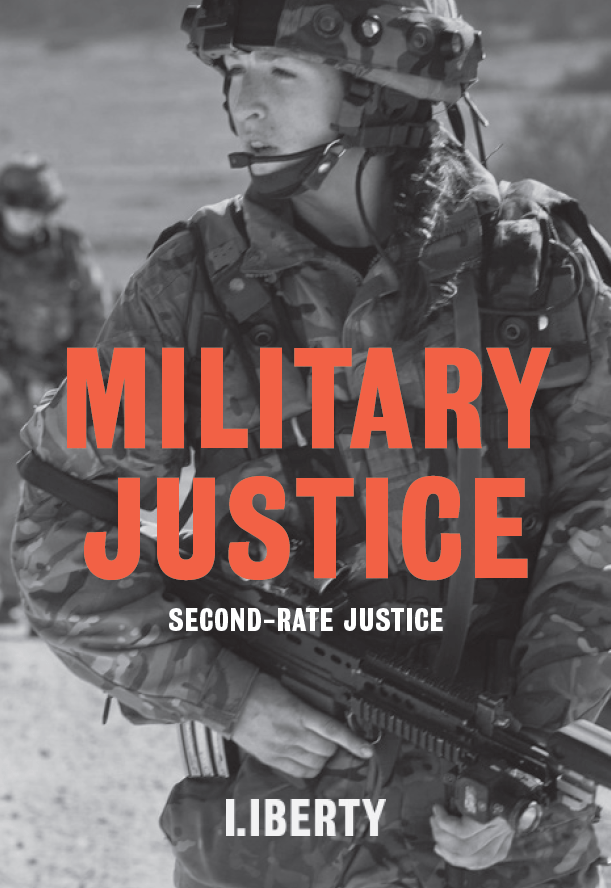
Liberty’s recent ‘Military Justice: Second-Rate Justice’ provides much needed clarity to this emotive and often misunderstood topic. It argues powerfully that far from being driven by a concern for soldiers, attempts by the Government to leave human rights treaties are self-serving and will very likely harm both victims of war and soldiers in the long run.

ForcesWatch decided to take a quick look at some of the key questions around the historical allegations debate.

Are the claims of abuse by UK troops simply ‘made up’?

No. Abuses and killings certainly took place. The scale can be contested but the fact that abuses took place and that UK troops killed civilians can not. Former senior British Army lawyer Lieutenant Colonel Nicholas Mercer branded claims that, for example, the Iraq allegations were spurious as ‘nonsense.’

… Read more

Personnel are being failed by the military justice system

Liberty are doing fantastic work in pushing for personnel to have adequate and equal legal protection, and in defending the Human Rights Act.

The failings in the military justice system that they detail increase our own concerns that young and vulnerable recruits are misled by manipulative military recruitment advertising and are not aware of the myriad ways in which the military system may fail them.

Not a system where women are ‘listened to.’

Recent military recruitment advertising has strategically targeted young people with videos claiming that the military will take better care of women, LGTBQI+ and BAME (Black, Asian and Minority Ethnic) communities than civilian employers. The military’s record on safeguarding rights and welfare is, however, woefully inadequate – and they recruit the youngest soldiers in Europe.

‘There is something very badly wrong with the way in which the armed forces investigates and prosecutes sexual crime.’ (p.53)

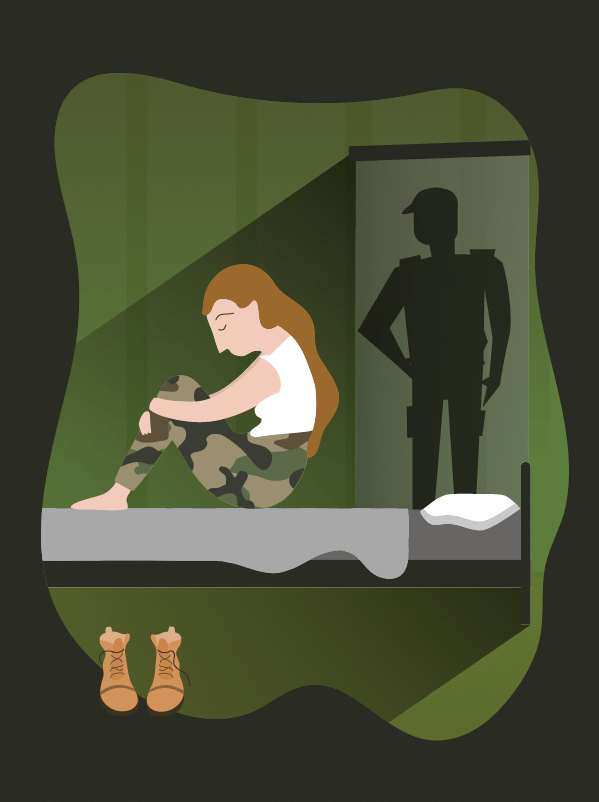
In Will I be listened to in the Army (Army recruitment video, 2018), an animated woman is small, vulnerable, overlooked and abused in the civilian world. She is then rescued by the military who empower her and give her a voice.

Yet Liberty’s ‘Military Justice’ report raises very serious concerns about sexual offending in the armed forces.… Read more

Martial Law and No-Deal War Games

Today Sky News reported that preparing for a no-deal Brexit is the ‘highest priority’ of the Ministry of Defence, and that ‘war games’ will be held by the armed forces in the coming days before a cross-government exercise at the end of February.

The military is preparing for disruption from blockages of goods to civil unrest, with soldiers making up the bulk of 3,500 personnel on standby for no-deal duties.

The most extreme reporting of potential military responses to a no-deal, from numerous media channels and newspapers, has suggested that martial law could be declared in the event of civil unrest.

While it is widely reported that Brexit planners are looking at the possibility of martial law, there have been no reliable projections yet about the likelihood of it occurring.

Given the sensationalism attached to some of the more click-hungry reportage we have seen, we thought it worth examining what martial law would actually entail.

Martial law, which is generally defined at the military taking control of the normal functions of the state, is more commonly associated with authoritarian and repressive regimes in the ‘developing world’.

Recent examples of large-scale military intervention in the running of nation-states includes those declared in areas of the Ukraine and the Philippines in 2018 and Turkey in 2016 following an attempted coup.… Read more

RAF100: A Short Counterhistory of Britain’s Air Force

There were two British military centenaries in 2018. One, in November, commemorated the end of the First World War. The other, officially in April but marked by events across the country all year, recalled the 100 years since the founding of Britain’s Royal Air Force (RAF). Implicit to this other centenary is the recognition of a key development in modern war-fighting which has come to play a key role, almost without exception, in wars fought since 1918: air power.

The RAF is the youngest of the UK’s three military services, having been formed from the British Army and Royal Navy as the bloody deadlock of the Great War drove the search for new ways of winning on the battlefield. Like the British Army and Royal Navy, the RAF has distinct sense of itself and occupies a unique place in the public consciousness. A place where technical skill and flexibility is favoured over the tough top-down discipline of the other parts of the military and where there is still space for a certain amount of dash and flair.

While accounted a critical voice within defence, former RAF officer, scholar and author Frank Ledwidge, whose 2018 book on air warfare was timed for the centenary, echoed this sentiment when he described the branch as being ‘less rigorous, less rigid, and allowing a little bit more for questioning than the other two services.’… Read more

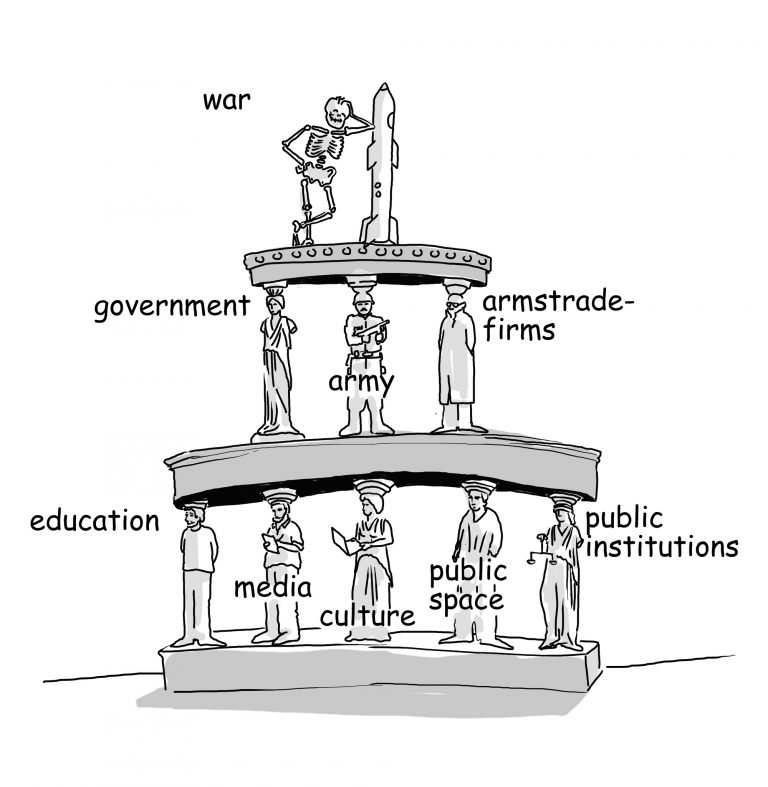
What is militarism?

Militarism is subject to many different definitions. This can make it hard to characterise for those seeking to expand their understanding of what is an important aspect of social culture.

Militarism, and the process of militarisation, is a broad and complex issue involving a diverse range of different groups and interests. While it has long been a central dynamic in British history, it has current manifestations that are particular to the present day.

ForcesWatch has found the following to be a useful starting definition of militarism:

  • The normalisation of war and preparation for war.
  • Prioritising the needs and interests of military institutions.
  • Extension of military culture and influence into everyday life such as in education, central and local government and business, charities etc.

The following quote by Cynthia Enloe is also useful for thinking about how this is taken on and internalised by individuals:

“To become militarised is to adopt militaristic values and priorities as one’s own, to see military solutions as particularly effective, to see the world as a dangerous place best approached with militaristic attitudes.” (Globalization and Militarism: Feminists Make the Link, 2007)

In our view there is a substantial body of evidence that these aspects of militarism have become intensified over the last decade or more.

… Read more