Take Action on Militarism 2017 pack launch
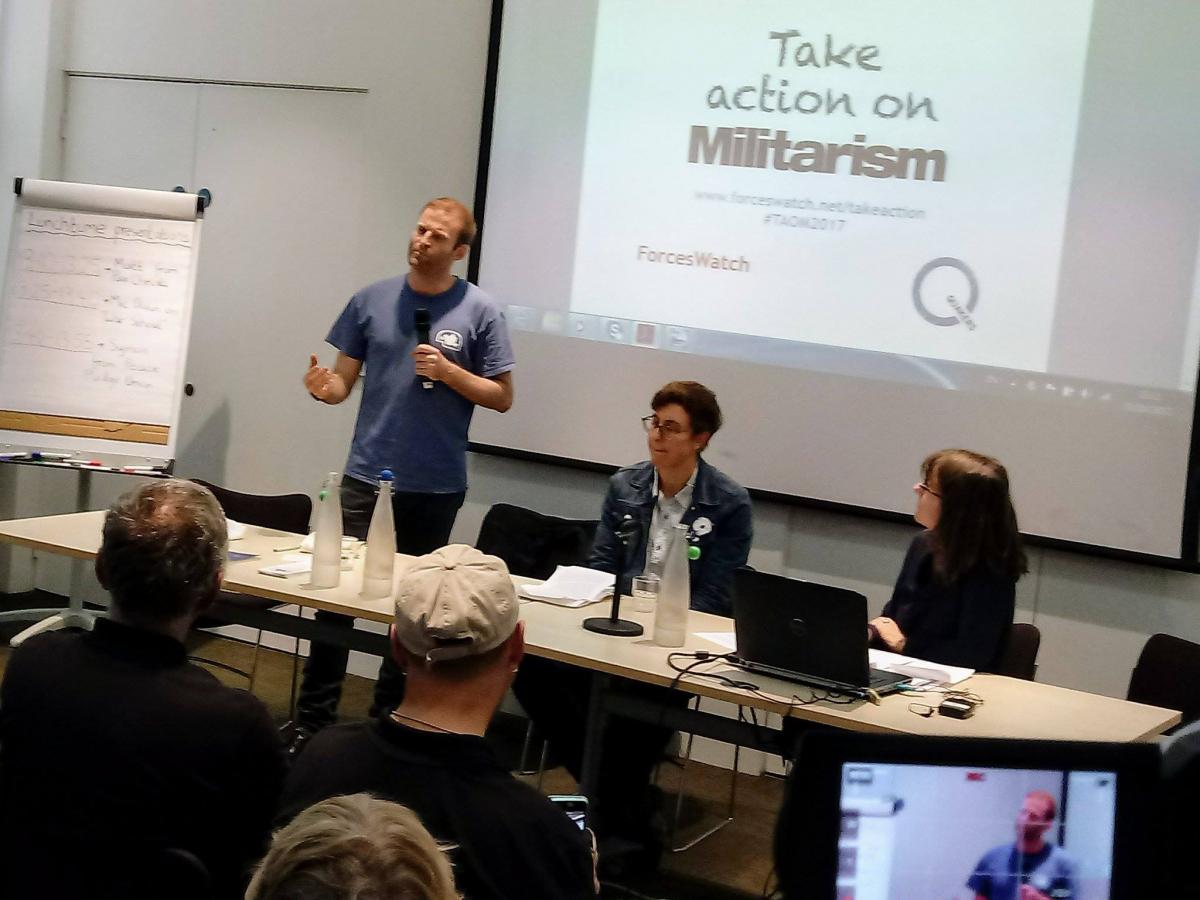
‘We’re really lucky to be in a movement, and it is a movement, trying to do something about militarism,’ says Sam Walton of Quakers in Britain. Sam Walton of Quakers in Britain was speaking at the Take Action on Militarism launch on 21 October 2017.

Just a few days later Sam was exonerated for attempting to disarm a British warplane heading to arm the Saudi-led war on Yemen.

#TAOM2017 launched the Take Action on Militarism pack which is designed to equip and support this movement. See here to download or order hard copies. 

The pack contains background information, key facts, case studies and tips for action on militarism. It has been produced by ForcesWatch and Quaker Peace and Social Witness. We are distributing copies for free, and we are raising money to help us do so on our crowdfunder page.
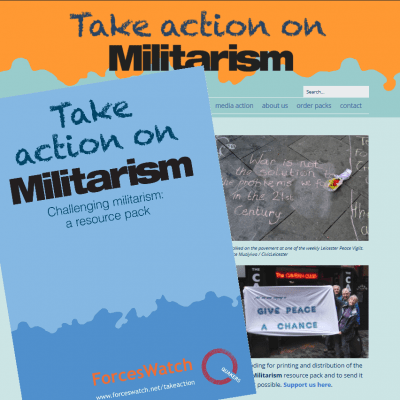
At the launch, we heard from 16 year old Scotland Against Militarism founder Jay Sutherland; Penny Walker and Ambrose Musiyiwa from Leicester for Peace; and Bernie Draper from the Merseyside Peace Network. They shared with us their personal stories, anecdotes, thoughts and advice from their local action on militarism: from instigating dialogue about militarised police forces, to flying the Pride/peace flag while protesting Armed Forces Day, to chalking messages for peace on the city centre pavement, to working with artists and engaging with alternative media sources.… Read more
Making it 18 – the SNP votes yes to raising the age of recruitment

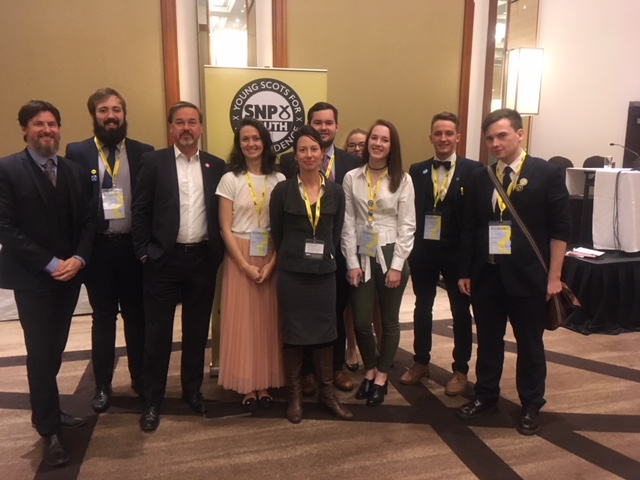
On the banks of the Clyde in Glasgow earlier this month the Scottish National Party passed a resolution backing raising the age of military recruitment to 18.

This Conference vote (Sunday 8 October) came after two years of hard work by the SNP’s youth wing, the YSI, who had won the backing of numerous members, MSPs and some MPs.

There were passionate speeches on both sides of the argument, but the young delegates won the day with overwhelming support in the hall when it came to a vote.

The key text of the motion read: Conference calls upon the UK Government to work towards raising the minimum armed forces recruitment age from 16 to 18 for all roles that require combat training in line with international standards and affirms that this will form a part of the SNP’s Defence Policy for an independent Scotland.

Work by ForcesWatch was used by those backing the change and the recent report by health professionals’ charity, Medact, on military recruitment was frequently cited.

Rhiannon Spear, national convener of the YSI told delegates that those who join at 16 and 17 are “more likely to suffer PTSD, alcohol abuse, self-harm, commit suicide and more likely to die or be injured in active service than older recruits.”… Read more

Is pushing the cadets really in pupils’ best interests?

An interim report praising the social mobility benefits of the cadet forces was published last week by the University of Northampton.

It states that cadet units can improve attendance and educational achievement, supporting children in ways that schools cannot, and was welcomed by the defence secretary Michael Fallon, who took the opportunity to announce 31 new units in state schools.

The continual promotion of cadets in schools by ministers, at a time when education and other services for young people are being severely cut, suggests that the government feels that it still needs to sell what is primarily a defence policy to the education sector.

This focus on cadets can only be understood in the context of government concerns about the shortfall in military recruitment. The recent report to the prime minister by ex-defence minister Mark Francois, Filling the Ranks, recommends more cadets units in schools, “with a particular emphasis on underprivileged and BAME areas”, and that careers in the armed forces should be promoted.

The MoD’s defence priorities are sometimes adverse to the best interests of the young people with whom it interacts

In fact, military activities in education, have always been about boosting recruitment and creating a widespread positive awareness of the armed forces.… Read more

The Ministry of Defence has no place in our schools

Cadet units can improve attendance and educational achievement, supporting children in ways that schools cannot, said an interim report on the social impact of cadet forces published this week by the University of Northampton.

Defence Secretary Michael Fallon praised the report while announcing 31 new cadet units in state schools.

The funding of the cadet expansion programme, part of nearly £90 million that has gone into military programmes in education since 2012, seems rather an anomaly.

In contrast, non-military services and facilities for young people have been decimated in recent years, and education is facing a funding crisis.

Teaching and support staff posts are being cut, along with Special Educational Needs (SEN) provision and spending on books and equipment. Funding for education of 16-19 year olds has been devastated.

Outside the classroom, the picture is equally bleak. Youth clubs have been so badly hit that they are closing up and down the country and may become once more reliant on Dickensian philanthro-capitalism.

Children’s mental health services have also faced cuts, with funding falling by nearly £50m between 2010 and 2015.

… Read more

Innovation not conformity

We approached Dr Brian Belton, a leading international authority on youth work, for his thoughts regarding this week’s publication of a report: What is the social impact resulting from the expenditure on cadets?, and the Defence Secretary Sir Michael Fallon’s subsequent announcement of further cadet expansion. The document is reporting interim finding after one year of a four year study by The Institute for Social Innovation & Impact at the Univeristy of Northampton.

We have previously written about the expansion of the cadet forces as a poorly thought-through policy that is part of a push to militarise education and wider society.

Dr Belton’s comments expose the euphemistic language that is employed by Fallon and the Ministry of Defence when eulogizing about the benefits of cadet forces and a ‘military ethos’ for young people. This language is reminiscent of Chomsky’s ‘manufacturing consent’ argument: (“That’s the whole point of good propaganda. You want to create a slogan that nobody’s going to be against, and everybody’s going to be for. Nobody knows what it means, because it doesn’t mean anything.”)

He also unpicks and challenges the idea that the values we are told a ‘military ethos’ will instil are the epitome of desirable attributes in young people.… Read more

Why We Must Take Children Out Of Military Environments

They are alleged to have kicked or punched the recruits during infantry training and smeared their faces with sheep and cow dung.

This is the Army’s largest ever abuse case and centres on the main training establishment for recruits under 18.

Among the many questions that must be answered, those examining the AFC Harrogate case should query the wider issue of causality: do military environments by nature facilitate threats to child welfare?

There are two military environments for children in the UK – military training for 16-18-year-olds, and the cadet forces.

While many benefit from and enjoy their time in the cadets and in military training, others suffer in the long and short-term as a result of behaviours that can be directly associated with key attributes of military environments.

These attributes include hierarchy, aggression, anonymity, stoicism to the point of repression, and authoritarianism. They facilitate abuse of power, cover-up through the chain of command, bullying, sexual abuse and a culture of silence.

High profile cases such as Harrogate, and the four Deepcut deaths, expose wider cultures of abuse and cover-up involving many people.

The statistics suggest that abuse is widespread in the armed forces. The most recent survey of armed forces personnel shows that 13% experienced bullying, harassment or discrimination in the last year.… Read more

Arms companies and immorality in education

This week the largest arms fair in the world will take place in East London. The Defence and Security Equipment International (DSEI) will be attended by more than 1500 defence exhibitors and traders, including those from authoritarian regimes or identified by the UK government as ‘human rights priority countries’, who have received official invitations. UK Government departments promoting these sales are also very present.

DSEI has attracted a record amount of protest this year – from an open letter signed by more than 250 academics to a mass of direct action at the exhibition centre, an art exhibition and education events. This reflects public disquiet with the activities of the companies that exhibit there and the license they are given by government to continue these activities.

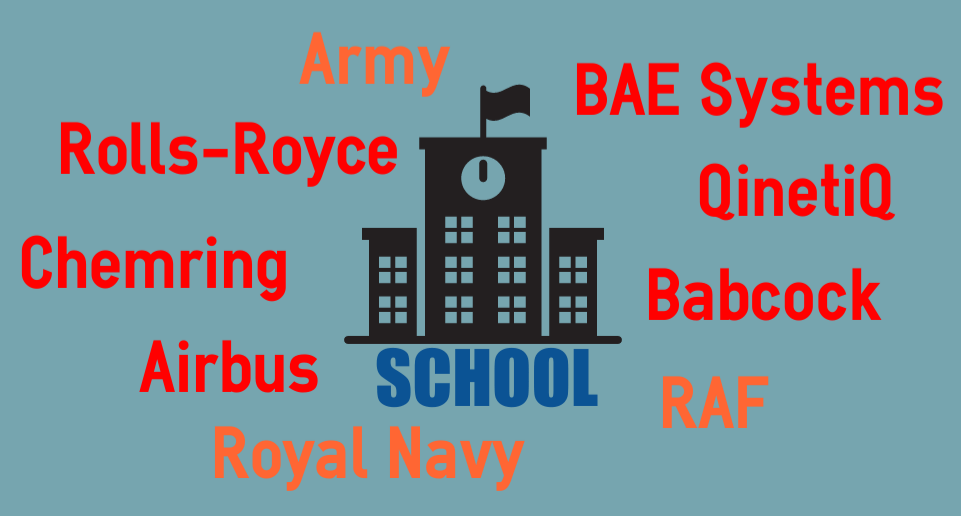
What is less generally known is the increasing involvement of these same arms companies in education in the UK. Many of the top names have a presence – BAE Systems (who are also a ‘platinum sponsor’ of DSEI), Rolls Royce, Babcock, QinetiQ, Chemring and others; some are big players, forging the way ahead, others are playing a smaller part. These arms companies feature in the top 100 companies supplying defence equipment and military services globally listed by Defence News and the Stockholm International Peace Research Institute (SIPRI).… Read more

Make Art Not War… or both?

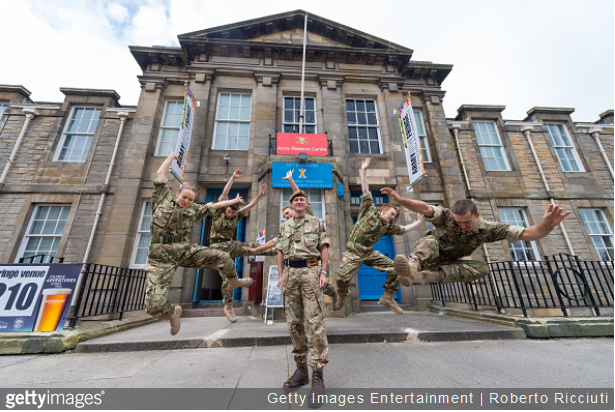
The Fringe festival has always been eclectic. Not an inch of Edinburgh is wasted as the whole city becomes a stage and all the people, merely players. But this year, on its 70th anniversary, the well-regarded Fringe venue Summerhall collaborated with a newcomer: the British Army. The Army Reserve Centre and Drill Hall in East Claremont Street transformed into a performance venue that was programmed and staffed by serving soldiers. This was billed as an opportunity to demystify the military, but should we be concerned that this particular kind of militainment is only the beginning of the Army’s engagement in the arts in Scotland and the UK?

I’m an anthropologist of militarism and a theatre-maker, so I felt I had to wonder down Leith Walk and make a visit to the drill hall-cum-theatre venue to take a closer look.

Many of the shows programmed by Army@theFringe dealt with subject matters such as race, gender, disability, mental illness and even imperialism. But here I am not interested in reviewing the shows as much as I am reviewing the politics of the Army hosting audiences at the Fringe.

… Read more

Army recruitment practices exploit and widen class divisions

In a powerful Guardian piece (Sunday, 9 July), damning evidence was revealed demonstrating that British Army recruitment marketing deliberately targets working-class young people. While it is not a surprise that the Army are targeting economically disadvantage parts of the country, they have always denied this.

The evidence is a marketing brief attained through Freedom of Information. The brief was given by the Army, and their recruitment agency Capita, to the advertising agency Karmarama. It spells out the key target audiences for the 2017 ‘This is Belonging’ Army recruitment marketing campaign, which we discuss here.

The ‘core regular target audience’ is described as:

“16-24, primarily C2DE. Mean household income 10K. High index for social, mobile, cinema Not heavy TV viewers. Interested in sports and spending time with friends.’

The brief also makes it clear that specific areas of the UK – poorer, northern and Welsh cities – are targeted by Army recruitment

The brief also makes it clear that specific areas of the UK – poorer, northern and Welsh cities – are targeted by Army recruitment:

“Please see below for highest indexing army locations, please consider to use these across all media channels. Leeds, Cardiff, Cleveland, Belfast, Nottingham, Manchester, Doncaster, Birmingham, Sheffield, Newcastle, Liverpool.”… Read more

Stripping the Civilian – how army training isolates, disorientates and dominates recruits

Many British army recruits are young and vulnerable. 22 out of every 100 UK army recruits are under eighteen – children, by international standards. At enlistment, British recruits are more likely to be 16 than any other age.

While multiple reports and studies demonstrate the dangerous long-term impacts of early enlistment and relate this to combat itself, little research has been done on the impacts of military training.

A new report from Veterans for Peace UK, released today (4 July 2017), tackles the nature and effect of military training using veterans’ testimonies and around 200 studies (mainly from the UK and USA).


The First Ambush? Effects of army training and employment
 is an in-depth exploration of the nature of training and what it does to recruits.

In short, the purpose of that training, from the initial stages onwards, is to mould young civilians as soldiers; to follow orders by reflex and to kill on demand.

That, the report explains, demands unquestioning obedience, aggression, antagonism. Normal inhibition to killing must be overpowered through a dehumanising training regime.… Read more