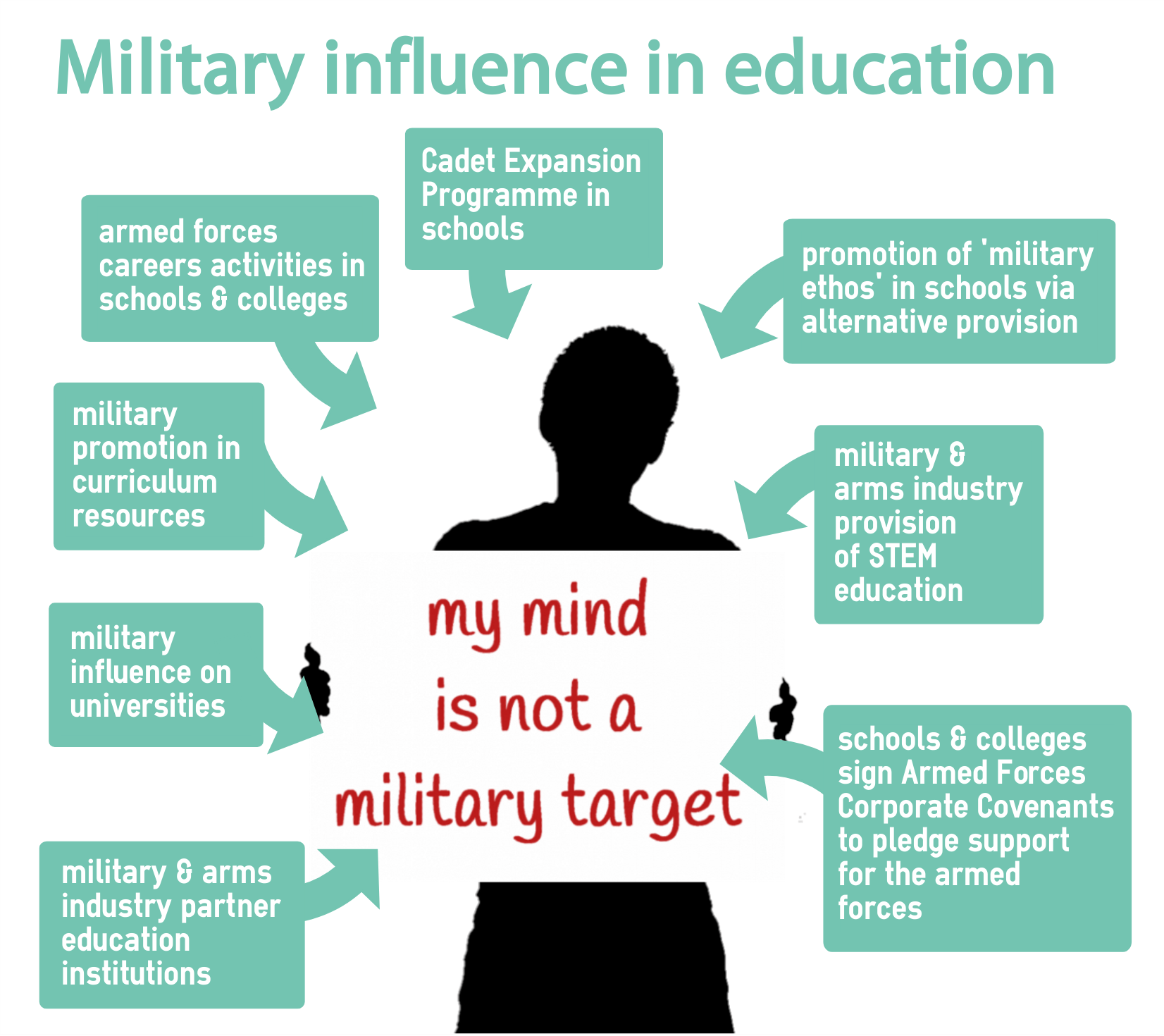
 The UK armed forces visit thousands of schools each year. They offer career presentations, curriculum resources and other activities aimed at promoting the interests of the military and long-term recruitment. Since 2012, the Department for Education have promoted ‘military ethos’ programmes such as cadet units in state schools and ‘alternative provision with a military ethos’.
The armed forces and arms companies are increasingly involved in the provision of STEM (science, technology, engineering and maths) activities for school and college students. and they also sponsor a number of careers-led secondary schools. The armed forces also now sponsor youth organisations like Girlguiding and Scouts. See more here.
Should the armed forces by given access to children within education? How can we challenge their activities in schools and colleges? How can a more balanced view of the military be given to young people?
While there are claims that school involvement is not about recruiting young people, the Ministry of Defence has itself stated that visits to educational establishments are a ‘powerful tool for facilitating recruitment’.
In having contact with young people, the military aim to sow seeds in impressionable young minds. In 2007, the head of the Army’s recruitment strategy said, “Our new model is about raising awareness, and that takes a ten-year span. It starts with a seven-year-old boy seeing a parachutist at an air show and thinking, ‘That looks great.’ From then the army is trying to build interest by drip, drip, drip.”
The influence of military interests in education and youth activities raises concerns around:
- recruiting-related activities in school
- child welfare issues
- the unrepresentative portrayal of the armed forces
- weapons in schools and at public events aimed at interesting children and teenagers in a military career
- the need for balance in teaching controversial issues
- the lack of balance with other career providers coming into schools
- the lack of parental consultation and policy scrutiny
- concerns around targeting disadvantaged areas and prioritising over other youth activities
- lack of balance with education for peace
- marginalising individuals and groups to do not wish to participate in military-related activities
See our briefing on Military involvement in education and youth activities in the UK.
We recognise the importance of debate and critical thinking in helping young people make an informed choice about the military and its activities. This is particularly important for those thinking of a career in the forces, a uniquely risk-laden occupation. If the military are allowed to have a presence and influence in the UK education system then it should be balanced by a thorough exploration of opposing views and approaches, as demanded by the 1996 Education Act.
Useful resources
Should the military be promoted in schools?
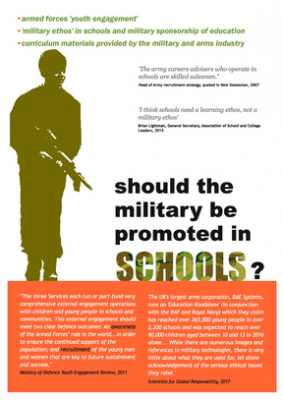 The armed forces have a growing involvement in secondary schools, colleges and even primary schools. While the Army, Navy and RAF have long run activities in schools as part of the Ministry of Defence's Youth Engagement programme, the Department for Education promotes 'military ethos' within education, and parts of the armed forces, along with the arms industry, are developing their involvement with curriculum provision and sponsorship of education institutions. This A4 leaflet (updated 2017) outlines the issue and what the concerns are.
This A4 leaflet (updated 2017) outlines the issue and what the concerns are.
The armed forces have a growing involvement in secondary schools, colleges and even primary schools. While the Army, Navy and RAF have long run activities in schools as part of the Ministry of Defence's Youth Engagement programme, the Department for Education promotes 'military ethos' within education, and parts of the armed forces, along with the arms industry, are developing their involvement with curriculum provision and sponsorship of education institutions. This A4 leaflet (updated 2017) outlines the issue and what the concerns are.
This A4 leaflet (updated 2017) outlines the issue and what the concerns are.
#GE2017: info & questions for candidates
Do You Know The Agenda Behind Your School’s STEM Provision?
Armed forces visits to Scottish schools – a ‘big issue’
Science for Society
 Science4Society is a collection of science education activities, which focus on the contribution that science, design and technology can make to peace, social justice and environmental sustainability.
The project was set up to provide an alternative to activities funded by the arms and fossil fuel industries and is co-ordinated by Scientists for Global Responsibility.
Science4Society is a collection of science education activities, which focus on the contribution that science, design and technology can make to peace, social justice and environmental sustainability.
The project was set up to provide an alternative to activities funded by the arms and fossil fuel industries and is co-ordinated by Scientists for Global Responsibility.
Teaching Remembrance: focusing on ‘why?’
Scottish petition makes headway
Rethinking Remembrance in Schools
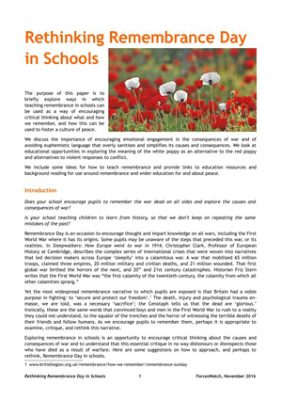 This paper, published by ForcesWatch, explores ways in which teaching remembrance in schools can be used as a way of encouraging critical thinking about what and how we remember, and how this can be used to foster a culture of peace.
Tory boost for cadets in schools needs fighting
This article was first published in the Morning Star
The Defence Secretary, Michael Fallon, recently announced that 25 out of 150 proposed new school cadet units would soon be opening. Despite the presentation of this development as new policy, the Cadet Expansion Programme promoting cadet forces in state schools, was first announced in 2012. While the Government heralds the cadets as a silver bullet in terms of improving pupil attainment and development, the sight of ranks of pupils as young as 12 in military gear and handling weapons will ring alarm bells for many. That this is happening within education raises additional concerns.